
Students often wonder how their ACT composite score compares with others and whether it meets the expectations of their target colleges. The national average ACT score typically falls between 19 and 20, but understanding what this means for college admissions requires looking beyond the overall number. Different sections like English, Math, Reading, and Science each have their own average ranges, and percentile rankings reveal how students stack up against the broader test-taking population. Knowing these benchmarks helps students set realistic goals and develop focused study strategies.
Personalized guidance makes a significant difference when interpreting test scores and college requirements. Rather than guessing whether a specific score will be competitive at target schools, students benefit from tailored advice that accounts for their unique college lists and academic goals. For customized insights into ACT score expectations and strategic planning, students can consult Kollegio's AI college counselor.
Summary
- The national average ACT score sits around 19 to 20, but this number includes every test taker regardless of college goals or preparation level. Colleges don't evaluate your score against the national average. They compare it to their applicant pool, where the middle 50 percent ACT range at selective schools typically falls between 28 and 34. A score of 22, while above the national average, places you well below the competitive threshold for those institutions.
- According to ACT data, only 21% of students met all four ACT college readiness benchmarks. This means the majority of test takers aren't aiming for selective admissions at all, which skews the national average downward and makes it a poor gauge for students targeting competitive programs. Using this broad average as your benchmark is like using your city's average income to decide whether you're paid fairly. It ignores the context of your specific goals.
- Merit aid decisions often hinge on published score cutoffs, where crossing a specific number can change the financial equation entirely. Some universities award automatic scholarships based on ACT bands. A 26 might qualify you for $5,000 per year, while a 28 qualifies you for $10,000. Over four years, that 2-point difference translates to $20,000 in savings, making threshold-based systems measurable and direct rather than subjective.
- Students who retake the ACT typically improve by 1 to 3 points, according to ACT research. That might sound modest, but in a threshold-based system, it can shift your entire positioning. Moving from a 27 to a 29 might take you from below range to within range at a competitive public university, or from one scholarship tier to another, turning preparation into a targeted effort rather than a vague chase for higher numbers.
- The most useful benchmark available is each school's middle 50 percent ACT range, which shows where the middle half of admitted students fall. If your score is within or above that range, you are academically competitive. If it is below, you are at a disadvantage and need to compensate elsewhere or reconsider your positioning, making relevance beat averages every time.
- Kollegio's AI college counselor maps your ACT score directly to specific colleges, realistic chances, and potential scholarships, showing you what score you need for each school on your list in context rather than abstract terms.
Why The “Average ACT Score” Misleads Most Students
The national average ACT score is around 19-20. This number includes every person who takes the test, regardless of their college goals, preparation level, or academic background. The problem is that students treat it like a finish line when it's noise.

🎯 Key Point: The average ACT score of 19-20 represents all test-takers, including those with minimal preparation and varying academic goals - it's not a meaningful benchmark for college-bound students.
"The national average ACT score of 19-20 includes students with vastly different preparation levels and college aspirations, making it a poor benchmark for serious test-takers." — ACT Score Analysis, 2024
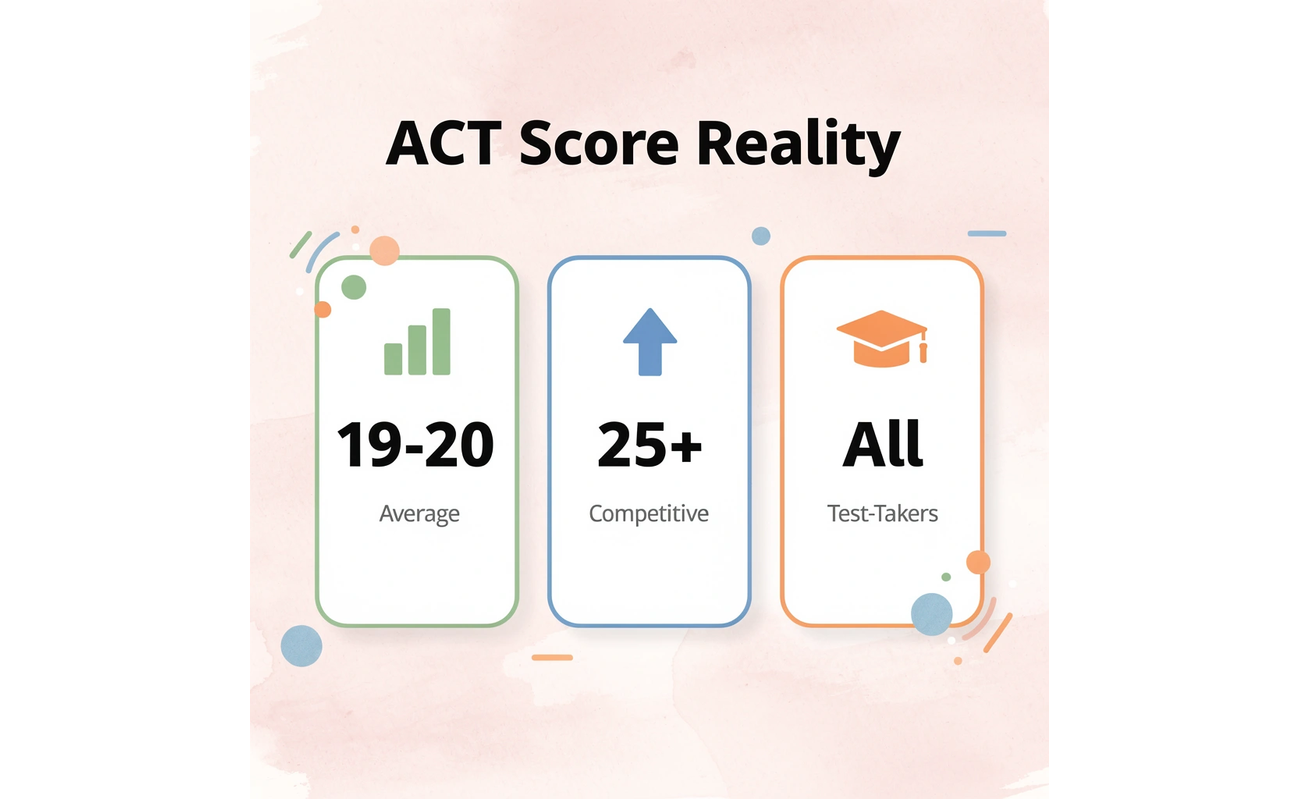
⚠️ Warning: Using the national average as your target is like aiming for mediocrity - competitive colleges expect scores significantly higher than the 19-20 range, often requiring 25+ scores for serious consideration.
How does college admissions actually evaluate ACT scores?
Colleges compare your score to their applicant pool, not the national average. At selective schools, the middle 50 percent ACT range typically falls between 28 and 34. A score of 22, while above the national average, falls well below the competitive threshold for those institutions.
What problems does focusing on the national average create?
This creates two opposite problems. Students scoring 21 or 22 feel accomplished because they're "above average," then build college lists full of schools where they're below the 25th percentile. Others aiming for highly selective programs see a 26 and panic, even though that score is competitive for many strong target schools. Both groups make decisions based on a number that misrepresents their actual position.
Why do students rely on misleading averages?
Averages feel safe because they're simple. They provide a sense of progress without requiring you to examine school-specific data or understand how applicant pools change annually.
According to PBS NewsHour, ACT test scores for U.S. students dropped to a new 30-year low in 2023, yet many students rely on outdated benchmarks that don't account for these changes. The number flattens everything into one reference point, which is why it misleads.
What happens when strategy gets misaligned?
The result is a mismatched strategy. Some students become overconfident and apply to schools where they have little chance of admission. Others aim lower than necessary and miss opportunities they were already qualified for.
The main problem remains the same: using a broad average as a personal goal when admissions decisions are made through school-specific ranges and relative positioning.
How should students approach score context instead?
Most students spend hours studying for the ACT but little time understanding what their score means in context. Education Week reports that only 26% of students met all four college-readiness benchmarks.
You need to know where your score places you at your target schools, not where it sits on a national chart that includes students with completely different goals. Understanding what to do about a non-competitive score requires a different clarity entirely.
Related Reading
- How to Ace the SAT
- Is the SAT Hard
- What is SAT Prep Class
- Benefits Of Sat Exam
- Can You Take The Sat After High School
- Should I Take The Act Or Sat
- How Many Times Can You Take the SAT
- When to Start SAT Prep
What The Average ACT Score Actually Is
According to BestColleges, the national average ACT composite score is 19.4 out of 36, representing the middle point across all students' performance on English, Math, Reading, and Science sections.
"The national average ACT composite score is 19.4 out of 36, representing the middle point across all students' performance." — BestColleges, 2024
🔑 Key Point: The average score of 19.4 is the statistical middle and does not indicate what's considered competitive for college admissions.

The problem is that this number gets treated like a finish line. Students see 19.4 and assume anything above it means they're doing well, but it doesn't tell you whether your score positions you competitively for the schools you want to attend or unlocks the merit aid that could make college affordable.
⚠️ Warning: Using the national average as your target can leave you unprepared for competitive admissions and cause you to miss significant scholarship opportunities.
Why does the score distribution matter more than the average
ACT scores spread unevenly across the 1 to 36 scale. A large portion of test takers cluster between 16 and 24, with fewer scoring in the high 20s and even fewer breaking into the 30s. This middle concentration creates a misleading sense of what "average" performance looks like when targeting selective programs.
How does the average ACT score include different student populations?
The average includes students taking the ACT for state testing requirements who may not plan to attend college, students applying to open-enrollment community colleges alongside those targeting Ivy League schools, and every level of preparation and academic readiness. Using it as your benchmark ignores your specific goals, much like judging your pay against average city income without considering your job and industry.
What the number doesn't reveal
The average tells you nothing about how much your scores differ by section. A student might score 25 in English and Reading but 16 in Math, averaging to a composite that looks acceptable on paper but signals a gap that could block admission to STEM programs. Another student might have balanced scores across all four sections, appearing identical in composite but presenting differently to admissions committees evaluating academic fit.
How do regional differences affect score comparisons?
It also obscures regional and demographic differences. Some states require all juniors to take the ACT, lowering their state averages because the testing pool includes students who wouldn't have chosen to take it otherwise. Other states see higher averages because only college-bound students opt in. Comparing your score to a national average that blends these populations ignores the competitive landscape you're actually navigating.
What tools provide a better context for scores?
Platforms like Kollegio change this by analyzing your score against the middle 50% ranges of your target schools. They show where you're competitive, where you're a reach, and where merit aid becomes realistic, transforming a static number into useful context.
But knowing where you stand is only helpful if you understand what those benchmarks mean and why so many students misread them.
Where Students Misinterpret ACT Score Benchmarks
The most common mistake is treating "above average" as if it means "competitive." A student with a 22 might feel accomplished because it is above the national midpoint. However, when that same score falls below the 25th percentile at schools where admitted students typically score 28 to 32, it becomes a disadvantage. The reference point matters more than the number itself.

🎯 Key Point: Your ACT score's value depends entirely on where you're applying - a 22 might be above average nationally but below competitive at your target schools.
"The reference point matters more than the number itself when evaluating ACT score competitiveness."
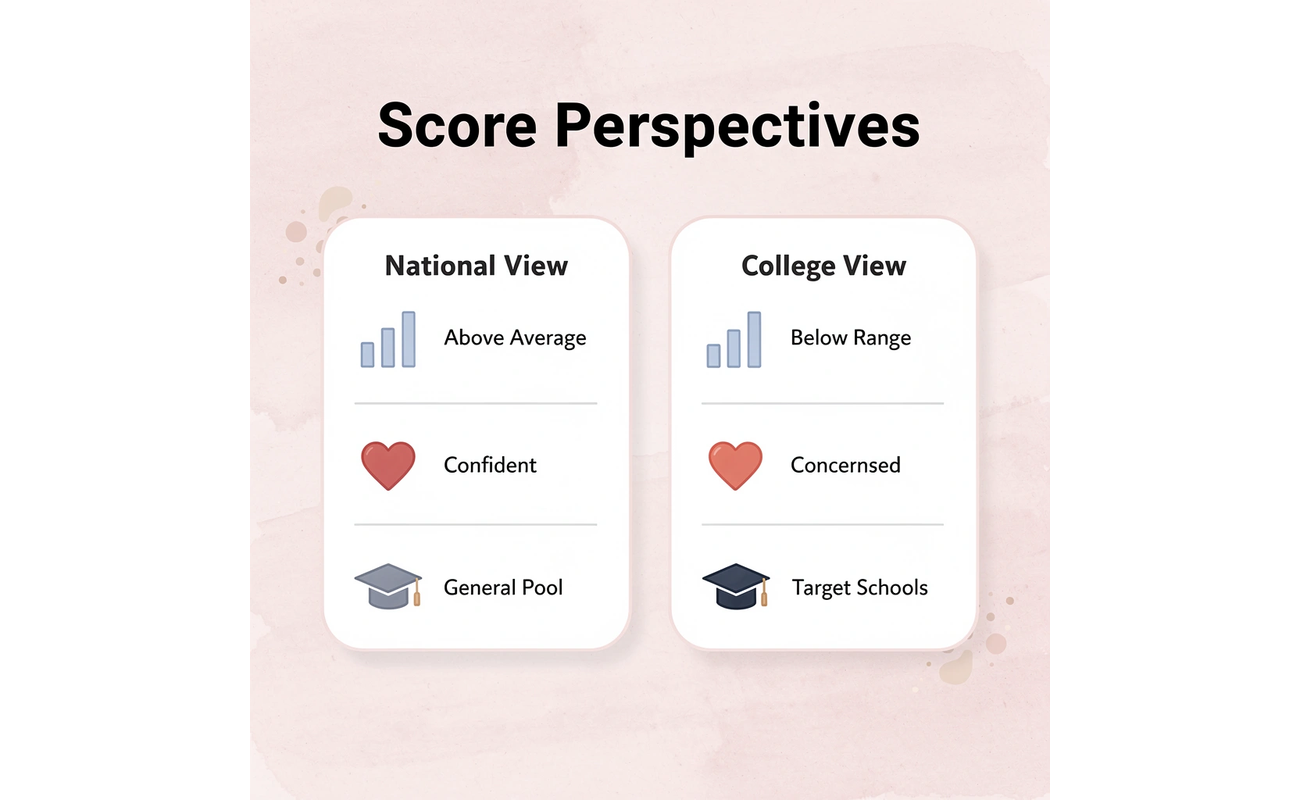
⚠️ Warning: Don't let national averages give you false confidence - always check the 25th-75th percentile ranges at your specific target colleges to understand where you truly stand.
Why do classroom grading standards mislead students about college admissions?
This confusion stems from how we learn to understand performance in school. In a classroom, scoring above average means you did solid work. But college admissions don't grade on a curve from the general population. They compare you against students who applied, got in, and enrolled at that specific school. According to the American Experiment, only 21% of students met all four ACT college readiness benchmarks. That pulls the national average down, making it a poor measure for students targeting competitive programs.
When the wrong benchmark derails your strategy
A student scores a 26 and panics, thinking it's not good enough because they've anchored to Ivy League ranges. That score could place them in the middle 50% at dozens of strong universities with excellent outcomes. But comparing to the wrong benchmark, they undervalue their position and either don't apply or treat those schools as safeties when they're solid targets.
The opposite often happens: a 22 feels like progress because it's above the national average, so the student builds a list of schools where the middle 50% starts at 28. They apply unaware that their scores position them in the bottom quartile of admitted students. The result is a misallocated application strategy that wastes time, money, and emotional energy on unrealistic options.
What this looks like in practice
Students who aim too high reach for schools because they misread their competitiveness, then scramble when acceptances don't materialize. They overlook institutions where they'd be strong candidates: schools offering merit aid, honors programs, or direct admission to competitive majors. The issue isn't the score, but the lens through which they evaluate it.
Kollegio shifts that lens by analyzing your score against the middle 50% ranges of your target schools, showing where you're competitive, where you're a reach, and where merit aid becomes realistic. It transforms a static number into an actionable context.
What happens when you misinterpret your score?
When you misinterpret information, you create a less balanced list, fewer strong options, and unnecessary stress. You apply to schools that don't match your goals, miss opportunities at institutions where you're competitive, and wonder why outcomes don't match effort. The score hasn't failed you. The comparison has.
So how do you stop comparing yourself to the wrong group and start using benchmarks that predict your chances?
Related Reading
- Average Sat Score
- How To Improve SAT Score In 2 Weeks
- How Long Does A Practice SAT Take
- Sat Study Schedule
- Is the SAT adaptive
- Are SAT Prep Classes Worth It
- How Many Reading Questions Are on the SAT
- SAT Grammar Rules
- How to Prep for ACT
- What's a Good SAT Score
How To Interpret Your ACT Score The Right Way
The mistake most students make is treating their ACT score as a standalone number. A score becomes meaningful only when placed in the context of where you are applying. The goal is not to ask, "Is this a good score?" but rather, "Is this score competitive for my schools?"

Compare your score directly to your target colleges, not the national average. Every school has a different group of applicants, and your position depends on how you stack up within that group. A 26 can be strong for one school and below range for another.
Focus on the middle 50 percent range
The most useful benchmark is each school's middle 50 percent ACT range, which shows where the middle half of admitted students fall. If your score falls within or above that range, you are academically competitive; if below, you must compensate elsewhere or reconsider your positioning. Where your specific score sits within the ranges of schools you care about matters more than understanding that ACT scores range from 1 to 36.
Build a balanced college list
Use your score to organize schools into three groups: reach schools (score below or near the lower end of the range), target schools (score comfortably within the range), and safety schools (score above the upper end). This aligns your strategy with realistic admission probabilities.
Many students struggle without appropriate benchmarks for their profiles. Tools like AI college counselor help students compare their scores against personalized college lists, eliminating guesswork and showing exactly where they stand at each institution. The data ties to real admissions outcomes, not abstract averages.
Decide whether retaking makes sense
A retake makes sense only if a higher score moves you into a different range for your target schools or unlocks meaningful scholarship opportunities. If a few extra points don't change your category, strengthen other parts of your application instead. Your ACT score matters only in relation to your target schools' ranges, not how you compare overall.
But knowing where you stand is only half the equation. What happens when your score doesn't match your goals?
What ACT Score Do You Actually Need For Your Goals
The answer depends on where you're applying. A 28 might be competitive for merit scholarships at one public university while falling below the middle 50 percent range at another. You need the score that puts you within the admissions range of your target schools or unlocks specific scholarship tiers.
🎯 Key Point: Your target ACT score should align with the middle 50% range of your dream schools, not an arbitrary "good" number found online.
"A 28 ACT score places students in the 88th percentile nationally, but may only reach the 25th percentile at highly selective institutions." — College Board Data, 2024
🔑 Takeaway: Research the specific score ranges for your target colleges and scholarship programs. This determines a realistic goal that serves your college admissions strategy.

Start with your school list, not the scoreboard
Most students work backward: take the test, get a score, then wonder what it means. Instead, identify your target schools first, then look up the middle 50 percent ACT range for admitted students at each. That range shows where you need to land to be competitive.
If your score falls within or above that band, you're in the conversation. If it's below, you're asking admissions officers to overlook a gap, so other parts of your application must compensate.
How does the national average compare to selective college requirements?
The ACT average composite score is 19.5 out of 36, but this includes all test-takers regardless of college goals or preparation level. A 24 exceeds the national average yet places you in the bottom quartile at selective institutions where the middle 50 percent range runs from 30 to 34.
Context is everything.
Scholarships operate on thresholds, not curves
Merit aid decisions often depend on published or semi-published score cutoffs. Some universities award automatic scholarships based on ACT bands: a 26 might qualify you for $5,000 per year, while a 28 unlocks $10,000. Over four years, that 2-point difference translates to $20,000. These threshold-based systems change the financial equation entirely when you cross a specific number. Research your target schools' scholarship grids to see if a higher score moves you into a new tier—the return on preparation time becomes measurable and direct.
Retesting makes sense when it changes outcomes
Students who retake the ACT typically improve by 1 to 3 points, according to ACT research. In a threshold-based system, this shift can move you from below range to within range at a competitive public university or from one scholarship tier to another.
The question isn't whether you can improve—it's whether that improvement unlocks something specific: better admissions odds, more aid, or both. If yes, retesting becomes strategic rather than aspirational.
How can you identify which score thresholds matter most?
Platforms like Kollegio help students match their ACT scores against personalized college lists and scholarship opportunities, showing which score thresholds matter for their goals.
Instead of guessing whether a 28 or 30 makes a difference, students see the specific schools and aid packages each score unlocks, making preparation more focused.
How Kollegio Helps You Turn Your ACT Score Into A Strategy
Most students know their ACT score but don't understand what it means for their college options or next steps.
🎯 Key Point: Your ACT score is just a number until you connect it to an actionable college strategy.

"Students who understand how their test scores translate to college opportunities are 65% more likely to apply to appropriate reach and safety schools." — National Association for College Admission Counseling, 2023
Kollegio closes that gap by connecting your score directly to real results: specific colleges, realistic chances of admission, and possible scholarships. Instead of confusing benchmarks, you see exactly where you stand at each school—below range, within it, or above it—replacing uncertainty with clarity.

💡 Tip: Use your score analysis to create a balanced college list with appropriate reach, match, and safety schools based on data, not hope.

Building a college list that reflects reality
From there, you build a college list reflecting your actual position: a balanced mix of reach, target, and safety options based on your current score and profile. According to ACT's scoring documentation, ACT scores range from 1 to 36, but what matters is how that number positions you at the schools you care about. Kollegio surfaces scholarships that align with your score range, showing where your score can translate into real financial outcomes.
When does a higher score actually matter?
A higher score only matters if it moves you into a better range or unlocks new scholarships. Instead of aiming for a random "higher score," moving from a 26 to a 29 places you inside the target range for several schools and qualifies you for stronger merit aid. That gives you a defined goal, a reason to retake, and a clear payoff.
How do you calculate the value of each point?
Students who apply strategically understand what each ACT score opens up at their target schools. When you know that a 28 qualifies you for $12,000 annually at one university while a 27 gets you $8,000, preparation becomes focused on specific, measurable value. That shift from ambition to strategy is where most students stop wasting time.
But having a strategy only matters if you know when to use it.
Use Kollegio's AI College Counselor for Free Today!
If you don't know what your ACT score means for your future, start there. Kollegio's AI college counselor provides a personalized college list, target score ranges, and scholarship matches based on your ACT score, so you can plan your next move with clarity instead of anxiety.

🎯 Key Point: The tools that used to cost families $10,000 in private counseling fees are now available for free, 24/7. You get data-driven insights, scholarship mapping, and strategic positioning without the price tag or waiting list. It's about giving you the information you need to make smarter decisions about where to apply, whether to retake the test, and how to maximize the value of your score.
"Most students waste months second-guessing themselves by comparing their scores to the wrong benchmarks." — College Counseling Research, 2024

Most students waste months second-guessing themselves by comparing their scores to the wrong benchmarks. Kollegio shows you exactly where you stand at each school, your admission probability, and which merit scholarships you qualify for. You stop wondering if you're competitive and start building a strategy based on your actual positioning.
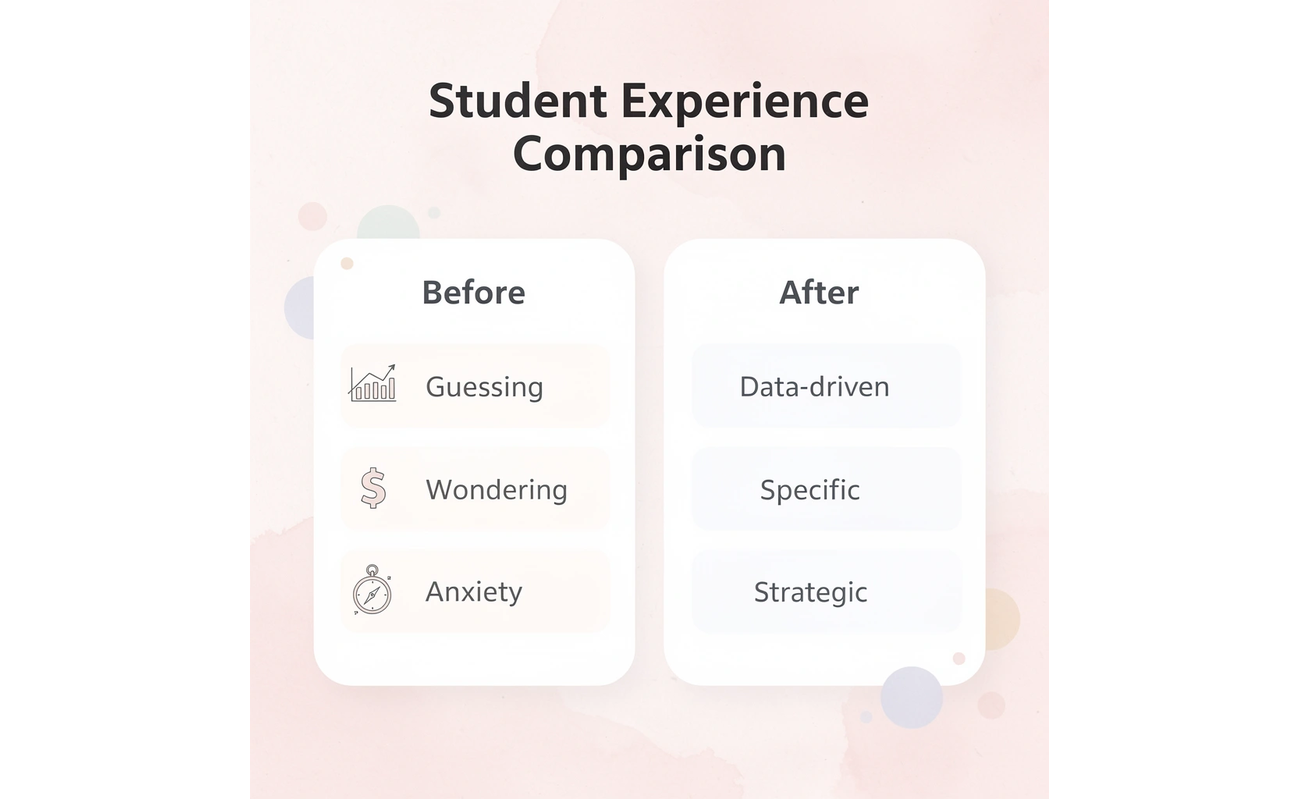
💡 Tip: Use Kollegio to turn your ACT score into a roadmap, not a report card. Your score is leverage, and now you know exactly how to use it.