
Aiming for an Ivy League school means understanding exactly where your SAT score stands before applications open. Knowing what ACT score is needed for Harvard or what SAT range Princeton expects gives students a concrete target to work toward, not just a vague sense of "scoring high." Elite admissions offices review test scores early, and a well-informed student knows how to position that number within the full application.
Real progress comes from comparing your score against actual admit data, not averages pulled from outdated guides. Students who know their gaps can focus their prep time on what matters most. For a clear, data-driven picture of where you stand and what to improve, start with Kollegio's AI college counselor.
Table of Contents
- Why So Many Students Worry About Their SAT Scores
- Do Ivy League Schools Have Minimum SAT Score Requirements?
- Average SAT Scores for Ivy League Schools
- Is Your SAT Score Competitive for the Ivy League?
- What Matters More Than SAT Scores in Ivy League Admissions?
- How Kollegio Helps Students Build Stronger Ivy League Applications
- Use Kollegio's AI College Counselor for Free Today!
Summary
- Stress about SAT scores is widespread among college applicants, and the anxiety is grounded in real data. According to the College Board's 2025 SAT Suite of Assessments Annual Report, only 39% of SAT takers in the class of 2025 met or exceeded both the Reading and Writing and Math college readiness benchmarks, down from 45% in the class of 2019. When fewer students are clearing benchmark thresholds, the competitive pressure at the top of the applicant pool intensifies.
- Ivy League schools do not publish minimum SAT score requirements, but their middle 50% ranges clearly reveal the competitive reality. Harvard's middle 50% SAT range is 1580-1600, and the average SAT score for admitted students across the top Ivy League schools is approximately 1550 out of 1600. These figures represent the center of gravity for an already highly self-selected applicant pool, not a floor that guarantees admission.
- The gap between national performance and Ivy League expectations is wider than most students realize. A 1400 SAT score places a student at the 93rd percentile nationally, yet it falls below the 25th percentile at every Ivy League school. This disconnect reflects how concentrated academic achievement is among students who self-select into elite applicant pools, rather than a flaw in the students or the scoring system.
- Once a score clears the competitive threshold for a given school, additional test prep offers diminishing returns. A score at or above 1500 generally removes test performance as a liability in the review process, while a score below 1450 places more pressure on every other application element to compensate. Students already scoring above 1500 typically gain more by investing time in essays, extracurricular depth, and application narrative than by chasing marginal score improvements.
- SAT scores are just 1 of more than 10 evaluated factors in Ivy League holistic review, according to PathIvy's SAT Score Guide. Essays, letters of recommendation, course rigor, and extracurricular activities all carry significant weight alongside test performance. Top Ivy League schools admit fewer than 5% of applicants, which means thousands of students with perfect or near-perfect SAT scores are rejected each year because the rest of their applications do not make a compelling enough case.
- The students who gain admission most consistently treat their application as a coherent argument rather than a checklist. Specificity matters: an applicant who built a tutoring network serving 200 students tells a fundamentally different story than one who lists tutoring as an activity. Course rigor, recommendation letters that capture intellectual curiosity, and essays that reveal genuine personal stakes all do work that no standardized test score can replicate.
- Kollegio's AI college counselor addresses this directly by giving students personalized essay feedback, benchmarking scores against real admissions data, and providing school-specific guidance that reflects the same holistic thinking admissions offices apply.
Why So Many Students Worry About Their SAT Scores
Stress about SAT scores isn't irrational. It's a logical response to a system that feels unclear, high-stakes, and unforgiving, especially when targeting schools with single-digit acceptance rates.
"SAT stress isn't a personal weakness — it's a rational reaction to one of the most high-pressure academic milestones students face."
🎯 Key Point: Feeling anxious about your SAT score doesn't mean something is wrong with you; it means you understand the real stakes involved.
⚠️ Warning: Dismissing SAT anxiety as an overreaction can prevent students from taking the proactive steps needed to improve their scores and reduce stress effectively.

Why does comparing scores online make anxiety worse?
Pressure intensifies when students compare themselves to peers online. A common pattern: students see someone with a 1580 SAT and a 4.0 GPA get rejected by Penn and conclude that anything less than perfection is disqualifying. This conclusion feels rational but relies on a skewed sample of the highest-performing applicants who self-report. The full picture is far more varied.
According to the College Board Newsroom's 2025 SAT Suite of Assessments Annual Report, only 39% of SAT takers in the class of 2025 met or exceeded both the Reading and Writing and Math college readiness benchmarks, down from 45% in the class of 2019. When fewer students hit benchmark thresholds, a strong score carries more weight relative to the pool, but student anxiety reflects a real and shifting standard rather than paranoia.
How do counselors and platforms shape what students believe is possible?
Many students treat the SAT as a measure of their entire academic worth, especially when college counselors suggest that scores below a certain level make them uncompetitive. Without independent guidance, students often accept these limits uncritically, narrowing their options before applying. Our Kollegio's AI college counselor counters that narrowing is unnecessary by giving any student direct access to real admissions data and personalized guidance.
Does a strong SAT score guarantee admission or just open the door?
SAT scores work as a threshold signal, not a ranking system. Once your score reaches a school's competitive range, admissions officers shift their focus to course rigor, intellectual curiosity, personal narrative, and sustained commitment. C2 Education notes that top colleges typically expect SAT scores in the 1500 to 1600 range, but clearing that range opens a door rather than guaranteeing entry. The score gets you considered; everything else determines what happens next.
A split profile—strong test scores with a lower GPA, or vice versa—doesn't automatically disqualify you. It creates a question your application needs to answer. Students who understand this treat their SAT score as one data point in a larger argument about who they are and what they'll contribute, rather than as a verdict. What you haven't seen yet is whether Ivy League schools publish the score thresholds that matter, and the answer is more complicated than most students expect.
Related Reading
- What ACT Score Is Needed for Harvard
- Average Act Score For Nc State
- Average Sat Score For Unc
- Average Sat Score For Umd
- Average Sat Score For Uc Berkeley
- Average SAT Score for Virginia Tech
- Average Sat Score For Brown
- Average SAT Score for UVA
- Average SAT Score for Michigan
- Average Sat Score For Ohio State
Do Ivy League Schools Have Minimum SAT Score Requirements?
Ivy League schools do not publish minimum SAT score requirements and will not reject you automatically based on a number. What matters most is the middle 50% score range, which shows where most of the admitted students actually scored.
"Ivy League schools do not publish minimum SAT score requirements — what truly matters is the middle 50% score range, which reveals where the majority of admitted students actually landed." — Top Tier Admissions
🎯 Key Point: There is no hard cutoff score at any Ivy League school — admissions are holistic, meaning your SAT score is one piece of a much larger puzzle.
⚠️ Warning: Don't assume a high SAT score alone guarantees admission. Scoring above the middle 50% range strengthens your application, but falling below it doesn't mean automatic rejection.
What Ivy League Schools Use | What They Ignore |
|---|---|
The middle 50% score range as a benchmark | Published minimum score cutoffs |
Holistic review of the full application | Single-number automatic rejections |
Score context within the applicant pool | Rigid score-based filtering |

What does the middle 50% SAT range actually tell you?
According to The Princeton Review, Harvard's middle 50% SAT score range is 1580 to 1600. This is not a minimum but a signal about the competitive reality of the applicant pool you would be joining. As BestColleges notes, a 1400 SAT score represents the 93rd percentile nationally, yet it falls below the 25th percentile at every Ivy League school. A student who outperforms nearly all test-takers still sits outside the typical range for Ivy admission, reflecting how concentrated elite applicant pools are.
How do testing policies vary across Ivy League schools?
Testing policies vary by school. Yale now requires standardized test scores, while Princeton has remained test-optional in recent cycles, according to their respective admissions pages. What works at one school may not work at another. Our AI college counselor at Kollegio provides personalized, school-specific guidance that would otherwise cost $10,000 with a private counselor.
What does a holistic review actually mean in practice
Holistic admissions is a framework that examines academic performance, course rigor, extracurricular depth, leadership, essays, and recommendations together. Two applicants with identical SAT scores can receive different outcomes based on the rest of their applications. The score provides context. The full application makes the argument. The absence of a hard cutoff is not ambiguity—it's an invitation to build a complete case. The numbers that admitted students earn, school by school, reveal how precise that case needs to be.
Average SAT Scores for Ivy League Schools
The middle 50% SAT ranges across Ivy League schools sit between 1430 and 1580, depending on the school. But what those ranges mean for your application is where most students get confused.
Ivy League School | Middle 50% SAT Range |
|---|---|
Highest Tier Schools | 1510 – 1580 |
Mid Tier Schools | 1470 – 1550 |
Lower Tier Schools | 1430 – 1510 |
"The middle 50% SAT ranges across Ivy League schools sit between 1430 and 1580 — but the range is not the target." — Applerouth, 2024
🎯 Key Point: The middle 50% range tells you where most admitted students land — not the floor you need to clear. Aiming for the top of the range is always the stronger strategy.
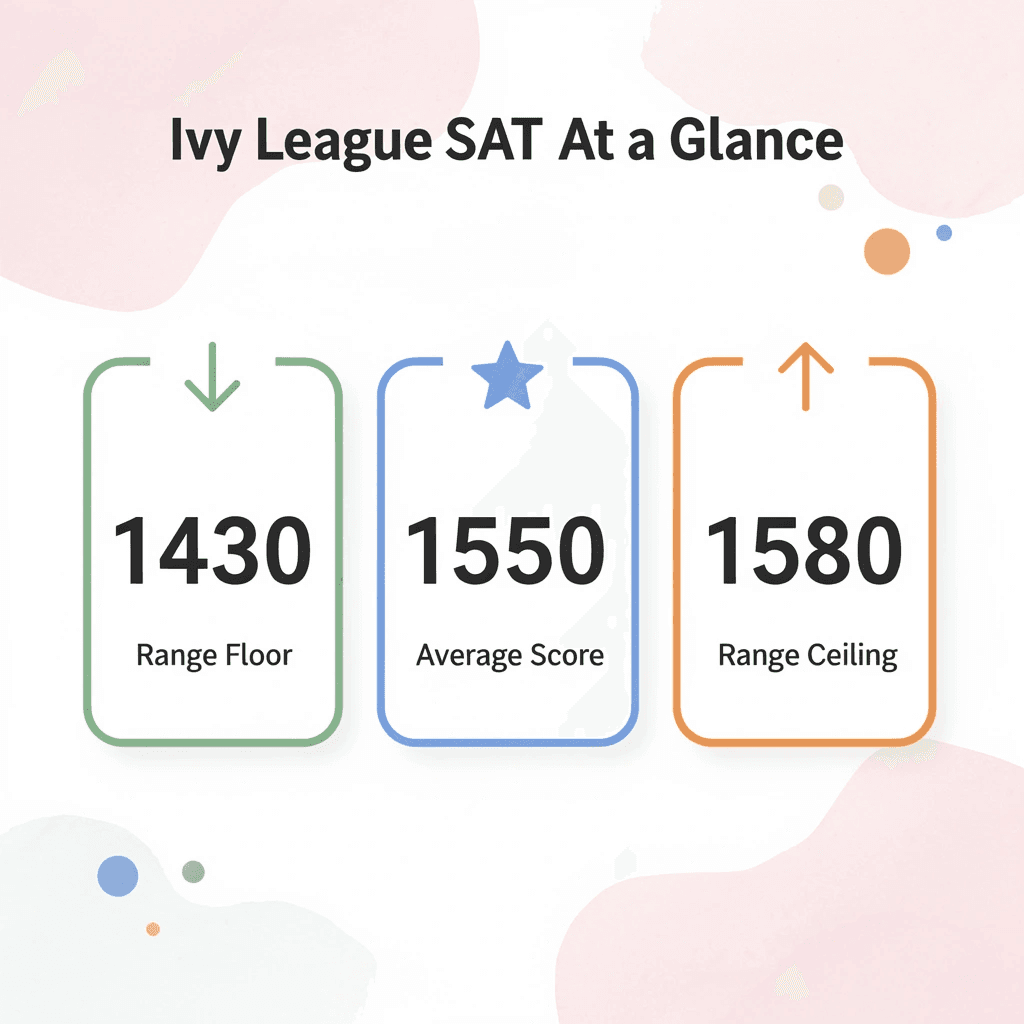
According to PathIvy, the average SAT score for admitted students at top Ivy League schools is around 1550 out of 1600. This represents the center of an applicant pool that is already among the most academically prepared in the world, not the minimum score. Scoring at or near 1550 puts you with other admitted students, not ahead of the process.
💡 Tip: Treat 1550 as your baseline benchmark, not your finish line. The students you're competing against are already hitting this number.
⚠️ Warning: A 1550 does not guarantee admission. Ivy League decisions weigh essays, extracurriculars, and recommendations alongside your SAT score. A perfect 1600 with a weak application still gets rejected.
What does the middle 50% range actually tell you?
The middle 50% range is a measure of a distribution, not a gate. Cornell's range starts at 1430, meaning roughly one in four admitted students scored below that. Harvard's range tops out near 1580, meaning roughly one in four admitted students scored above it. The range shows where most admitted students land: useful information for deciding where to focus preparation and which schools to treat as realistic targets.
How can organized access to score data change your college planning?
Most students cobble together research from school websites, Reddit threads, and outdated blog posts, creating guesswork and worry. Our AI college counselor at Kollegio uses thousands of data points to deliver personalized college recommendations and score benchmarking without the $10,000 price tag of a private counselor. The information has always existed; organized access tailored to your profile changes the equation.
How each school's range reflects its applicant pool
The pattern across all eight schools is consistent: the higher a school's overall selectivity, the tighter and higher its SAT range. BestColleges reports that a 1400 SAT score represents the 93rd percentile overall but falls below the 25th percentile at every Ivy League school. This gap reveals how concentrated academic achievement is at the top of the applicant pool. A score that would distinguish you in most contexts becomes average in this one.
Where do individual Ivy League schools fall within the SAT spectrum?
Cornell and Brown are at the lower end of the Ivy League SAT spectrum, with 25th percentile scores around 1430 and 1440, respectively. Harvard and Yale are at the upper end, with 75th percentile scores reaching 1580. Score ranges vary across schools, but the holistic review process remains consistent. Knowing where your score falls within these ranges is only the beginning.
Is Your SAT Score Competitive for the Ivy League?
Your score doesn't exist on its own. It lives inside a group of applicants, and where it lands within that group determines how much work the rest of your application needs to do.
🎯 Key Point: Your SAT score is never evaluated in isolation — it's always measured relative to the applicant pool you're competing against.

A 1400 SAT score is really impressive by any national standard. According to BestColleges, a 1400 represents the 93rd percentile nationally but falls below the 25th percentile at every Ivy League school. That gap reveals an important truth: the Ivy applicant pool isn't a national sample — it's a self-selected group of students who have been preparing and competing at an unusually high level for years.
"A 1400 SAT score sits at the 93rd percentile nationally, yet falls below the 25th percentile at every Ivy League school." — BestColleges
Benchmark | SAT Score | What It Means |
|---|---|---|
93rd Percentile (National) | 1400 | Top 7% of all test-takers |
25th Percentile (Ivy League) | 1400–1500+ | Below the Ivy floor |
75th Percentile (Ivy League) | 1550–1580 | Competitive range |
🔑 Takeaway: The same score that makes you exceptional nationally can make you below average in an Ivy applicant pool — understanding this gap is critical to building a realistic college strategy.
⚠️ Warning: Don't benchmark your SAT competitiveness against national averages. Always compare your score to the 25th–75th percentile range of your specific target schools.
What does a 1450 versus a 1550 actually signal to admissions readers?
The difference between a 1450 and a 1500 isn't 50 points—it's whether admissions readers flag your score as a possible gap. A 1500 sits comfortably within the middle 50% range at most Ivy League schools and clears the threshold where test scores stop being a problem. A 1450 can be competitive, but it puts more pressure on other application elements. A 1550 or above removes the SAT from consideration, letting readers focus on who you are rather than academic strength.
Does a below-average score automatically disqualify a strong applicant?
Most students compare their score to a school's published average and conclude: above average means safe, below average means out. Admissions offices don't work this way—they build classes. A student with a 1460 who conducted original research, led a community initiative, or showed rare intellectual focus can be more interesting than a student with a 1570 and a standard profile. Platforms like Kollegio help students see where their full profile stands, not just their test score, using personalized recommendations that reflect how admissions offices actually think.
What a perfect score still can't guarantee
According to PathIvy's SAT Score Guide, Harvard's middle 50% SAT range is 1580 to 1600. At that level, the SAT demonstrates academic preparation but cannot reveal character, original thinking, or the specific contribution a student will make to campus. Every year, applicants with perfect or near-perfect scores are rejected because those qualities don't emerge elsewhere in their applications.
When does more test prep stop being worth it?
If your score falls below 1450, it's worth trying to improve it. If you're already at 1500 or above, spending more time on test prep yields diminishing returns. Your energy is better spent on essays, extracurricular impact, and academic direction: the parts that scores cannot show. A higher SAT score rarely saves a weak application, but a strong application regularly overcomes an imperfect score.
What do Ivy League admissions offices actually prioritize when scores look similar?
Once you understand where your score fits, a harder question emerges: what do Ivy League admissions offices prioritize when scores look similar across hundreds of applicants?
What Matters More Than SAT Scores in Ivy League Admissions?
Admissions officers at Ivy League schools build a class of people who will challenge ideas, lead initiatives, and contribute to communities beyond campus. According to PathIvy's SAT Score Guide 2025, SAT scores are just 1 of more than 10 factors that are evaluated in holistic review, with essays, extracurricular activities, and letters of recommendation carrying significant weight alongside academics.
"SAT scores are just 1 of more than 10 factors evaluated in holistic review — with essays, extracurriculars, and recommendations carrying significant weight." — PathIvy SAT Score Guide, 2025
🔑 Takeaway: A perfect SAT score alone will not guarantee admission — Ivy League schools weigh at least 9 other factors just as seriously as your test results.
💡 Tip: Focus on building a well-rounded application by investing equal energy into your personal essays, leadership activities, and recommendation relationships — not just test prep.
Admissions Factor | Weight in Holistic Review |
|---|---|
SAT/ACT Scores | 1 of 10+ factors |
Essays | Significant weight |
Extracurricular Activities | Significant weight |
Letters of Recommendation | Significant weight |
Academic Rigor & GPA | Significant weight |

What actually separates admitted students
The failure point is usually specificity. Most rejected applicants have strong grades, respectable scores, and a list of activities. What they often lack is a clear throughline: a coherent story about who they are, what they care about, and what they have done about it. An applicant who founded a tutoring network serving 200 students in their district tells a different story than one who lists "tutoring" as an activity. The first demonstrates initiative, scale, and follow-through.
Why does course rigor matter more than a single strong score?
Course rigor demonstrates something a test score cannot: sustained excellence under pressure, week after week, over years. Admissions officers read transcripts seeking that pattern of sustained challenge, not a single impressive data point.
How do essays and recommendations make an applicant memorable?
Essays and recommendations are where the human being shows up in the application. A recommendation letter stating "she asked questions no one else in the class thought to ask" carries more weight than a generic letter praising effort. An essay revealing genuine intellectual curiosity, a specific formative experience, or an honest moment of failure and recovery makes an applicant memorable when a committee reviews hundreds of nearly identical academic profiles in a single week.
What mindset shift separates students who get in from those who don't?
Most students approach this process with a checklist: study, score, submit. But admitted students treat their applications as arguments rather than forms. They make a case for why their particular combination of experiences, values, and ambitions belongs in that specific community. PathIvy reports that top Ivy League schools admit fewer than 5% of applicants, meaning thousands of students with perfect or near-perfect SAT scores are rejected annually, not because their scores failed them, but because the rest of their applications do not make a compelling case.
Students who lack access to expensive private counselors often spend the most time on parts they can control least, like chasing a slightly higher test score, and the least time on parts that differentiate them. An AI college counselor like Kollegio addresses this directly by giving any student, regardless of zip code or budget, personalized essay feedback, activity guidance, and the strategic clarity that used to cost thousands of dollars.
Related Reading
- What Sat Score Is Required For Uf
- Average Sat Score For Uga
- Average Act Score For Georgia Tech
- Northwestern Average SAT Score
- Average Sat Score For Georgetown
- Rice University Average Sat Score
- Caltech Average Sat Score
- What Is The Combined Essay Score For Sat
- What SAT Score Is Required for Cornell
How Kollegio Helps Students Build Stronger Ivy League Applications
Getting into an Ivy League university takes strong grades, challenging coursework, leadership experience, extracurricular activities, compelling essays, and thoughtful application planning. Many students struggle with understanding how all these pieces work together — and how they compare to other applicants in an increasingly competitive pool.
Application Component | Why It Matters |
|---|---|
Strong Grades | Demonstrates academic excellence and consistency |
Challenging Coursework | Shows willingness to push beyond comfort zones |
Leadership Experience | Highlights initiative and real-world impact |
Extracurricular Activities | Reveals character, passion, and depth |
Compelling Essays | Your only chance to speak directly to admissions officers |
Application Planning | Ensures nothing critical falls through the cracks |
"Ivy League admissions is not a checklist — it's a holistic picture of who you are, what you've built, and where you're headed." — Kollegio Admissions Insight
🎯 Key Point: The biggest mistake students make is treating each application component in isolation. Ivy League admissions officers are looking for a cohesive narrative — one where your grades, activities, and essays all reinforce the same story.
⚠️ Warning: Relying on guesswork or unverified online forums for admissions strategy is one of the most common — and most costly — mistakes a student can make.
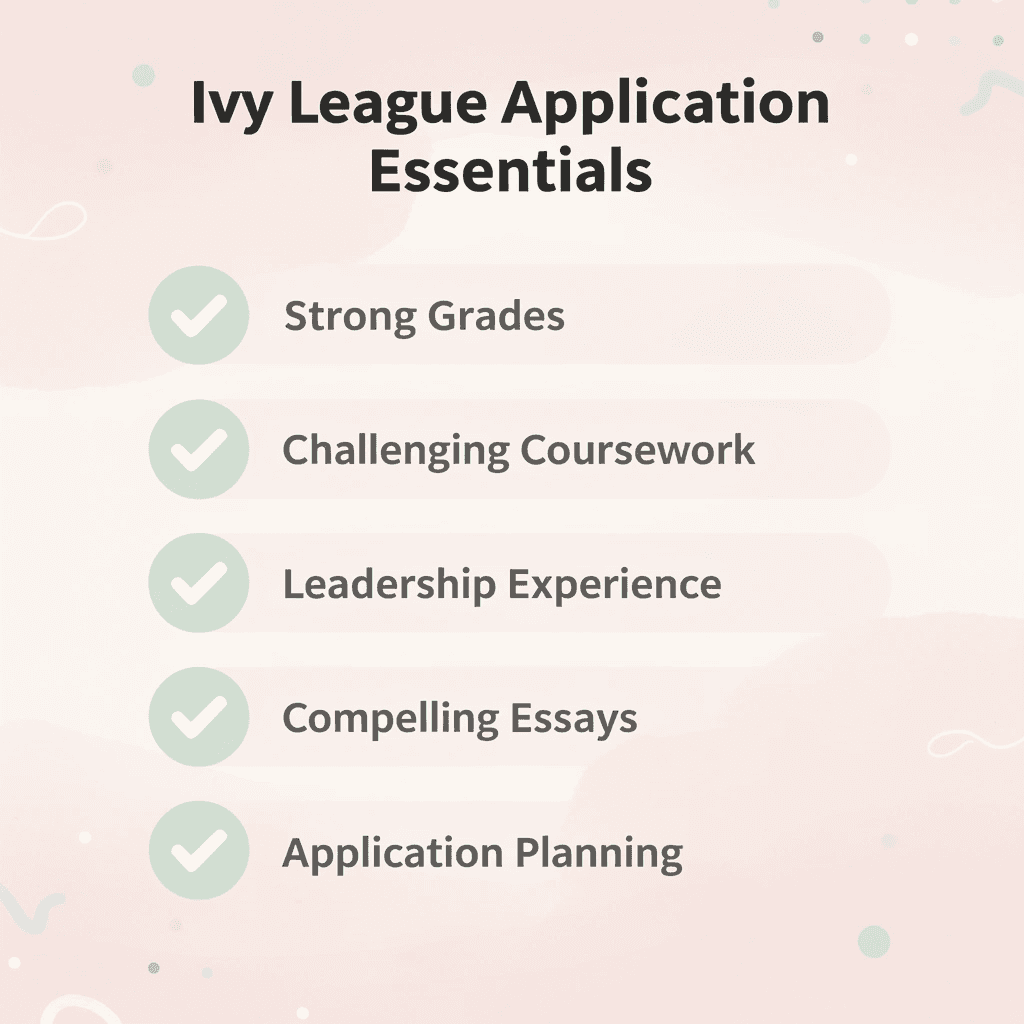
Kollegio provides personalized college guidance to help students navigate the entire admissions process with clarity and confidence. Rather than relying on guesswork or unverified online forums, our AI college counselor gives students access to powerful tools and data-driven insights to help them understand their academic profile and university options.
💡 Tip: Use Kollegio's AI college counselor in your sophomore or junior year to give yourself maximum time to strengthen your profile before applications open.
✅ Best Practice: Students who combine personalized guidance with a clear understanding of their competitive standing are better positioned to craft applications that stand out to Ivy League admissions committees.
How does Kollegio help students find the right university match?
University matching is one of the most useful features. Students can explore colleges that match their academic achievements, interests, goals, and admissions competitiveness, finding ambitious reach schools along with strong match and safety options that support a balanced application strategy.
Kollegio provides admissions insights explaining what universities seek in applicants. By evaluating academic performance and key factors, students gain a clearer picture of their competitiveness for specific institutions. Understanding how SAT scores compare with those of previously admitted applicants provides important context for identifying strengths, addressing weaknesses, and making strategic decisions about where to apply.
How does Kollegio support planning, scholarships, and a balanced college list?
Our platform helps students stay organized throughout the college application process: researching universities, managing deadlines, requirements, and admissions goals. Kollegio helps students find scholarship opportunities, making it easier to identify sources of financial support. Perhaps most importantly, Kollegio encourages students to look beyond rankings. Building a balanced college list that includes reach, match, and safety schools leads to stronger admissions outcomes and more opportunities.
Use Kollegio's AI College Counselor for Free Today!
Knowing Harvard's middle 50% SAT range or understanding holistic review creates an advantage only when you apply that knowledge to your specific profile, essays, activities, and goals—not a generic checklist.
"Raw admissions data only becomes a competitive edge when it's mapped to your unique profile, strengths, and story—not applied as a one-size-fits-all formula." — Kollegio
🔑 Takeaway: Statistics and trends are powerful only with a personalized strategy behind them. Without tailored guidance, even the best data leaves you guessing.
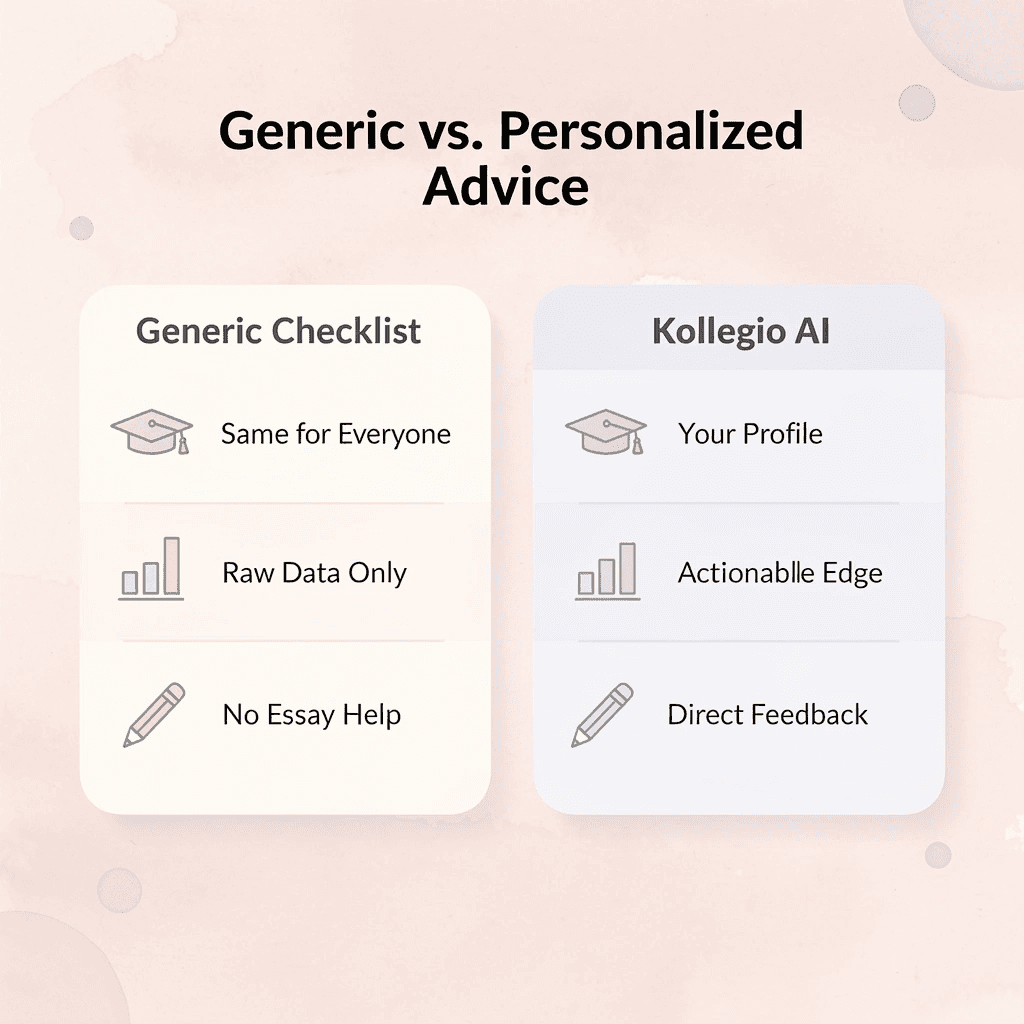
That's exactly what Kollegio was built for. Our AI college counselor gives you personalized essay feedback, scholarship matching, activity guidance, and shows how your academic profile compares to admitted students at schools that truly fit you.
Kollegio Feature | What It Does For You |
|---|---|
Personalized Essay Feedback | Strengthens your unique voice and narrative |
Scholarship Matching | Connects you to relevant funding opportunities |
Activity Guidance | Position your extracurriculars for maximum impact |
Profile Comparison | Shows how you stack up against admitted students |
🎯 Key Point: Every feature inside Kollegio is designed to make every single part of your application work harder and smarter for you.
💡 Tip: Start using Kollegio for free today—the sooner you begin, the more time you have to refine your application into its strongest possible version.
Related Reading
- What SAT Score Is Required for Duke
- What Sat Score Is Required For Mit
- What Sat Score Is Required For Columbia
- What Sat Score Is Required For Nyu
- What Is The Combined Essay Score For Sat
- What Sat Score Is Required For Ut
- What Sat Score Is Required For Ucla
- What Sat Score Is Required For Harvard
- What Sat Score Is Required For Stanford
- What Sat Score Is Required For Princeton
- What Sat Score Is Required For Cornell
- What Sat Score Is Required For Yale
- What Sat Score Is Required For Notre Dame
- What Act Score Is Needed For Alabama
- What Sat Score Is Required For Texas A&m