
What SAT Score Is Required for Stanford? A Guide for Applicants
Stanford's SAT expectations are a practical starting point for any serious applicant. The university does not publish a minimum score, but its admitted students consistently fall within a narrow, highly competitive range that sets a clear benchmark for preparation. Understanding where that range sits helps students set realistic targets and structure their study plans accordingly.
Score expectations are only one piece of Stanford's holistic review process, which also weighs coursework rigor, extracurriculars, essays, and recommendations. Students who want to see how their full profile measures up against those standards can get tailored, step-by-step direction from Kollegio's AI college counselor.
Table of Contents
- Why Students Want to Know Stanford's SAT Requirements
- What SAT Score Is Required for Stanford?
- How Competitive Is Stanford Admission?
- Is Your SAT Score Competitive for Stanford?
- What Else Does Stanford Consider Besides SAT Scores?
- How Kollegio Helps Students Evaluate Their Chances at Competitive Universities
- Use Kollegio's AI College Counselor for Free Today!
Summary
- Stanford's middle 50% SAT score range for enrolled students is 1500-1570, with an average of 1540, according to PrepScholar. Nearly all successful applicants score at or above the 98th percentile nationally, according to AdmitStudio. Despite those numbers, Stanford publishes no minimum SAT cutoff, which leaves students filling the silence with their own assumptions about what the score actually determines.
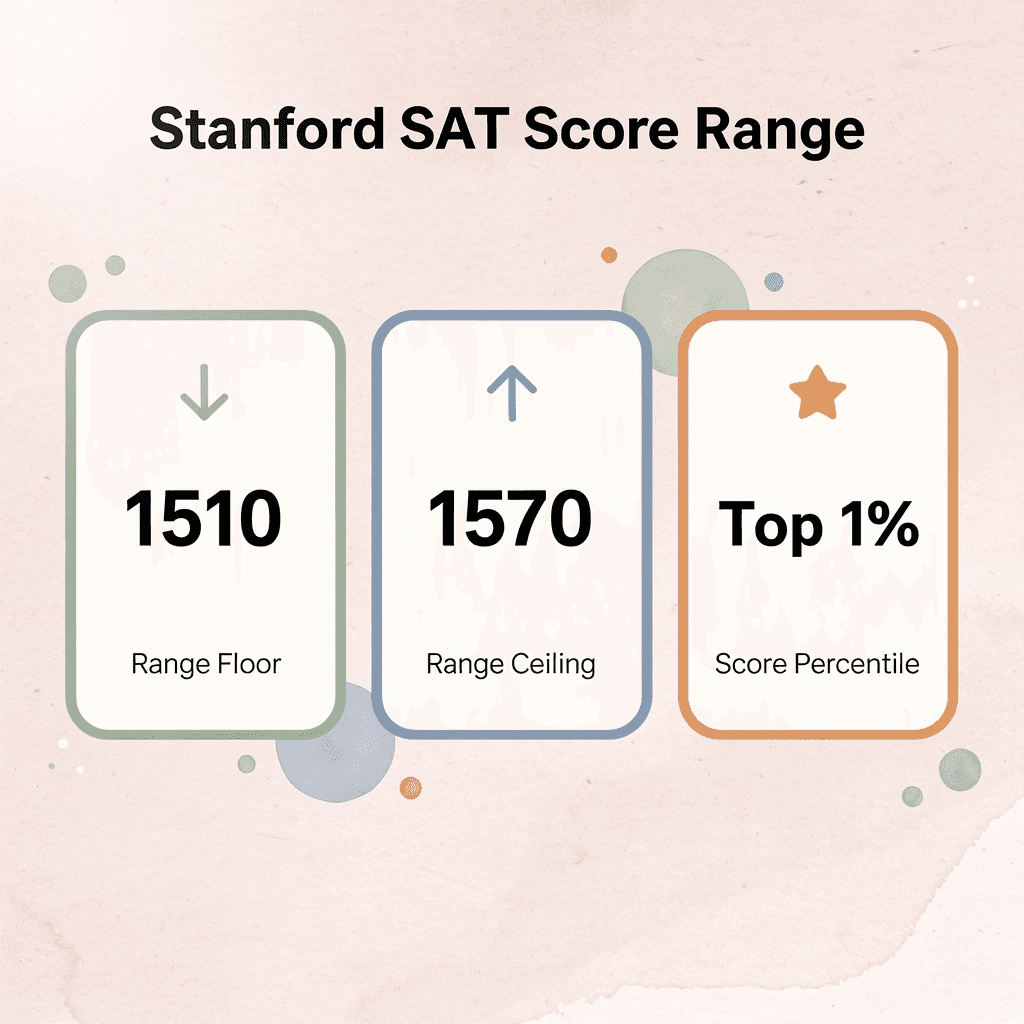
- Stanford is test-optional, meaning students can choose whether to submit scores at all. For those who do submit, the 1510 to 1570 range describes the middle 50% of admitted scorers, not a formula for admission. A quarter of admitted students scored below 1510, and a quarter scored above 1570, which makes the range a description of who got in rather than a threshold that predicts outcomes.
- Hitting the competitive score range confirms academic readiness, but it does not differentiate an applicant. When thousands of students share a similar score, that score becomes background noise rather than an argument for admission. Students with scores well inside the competitive range are rejected every cycle while students at the lower end gain admission, a pattern that reflects how little the score alone determines.
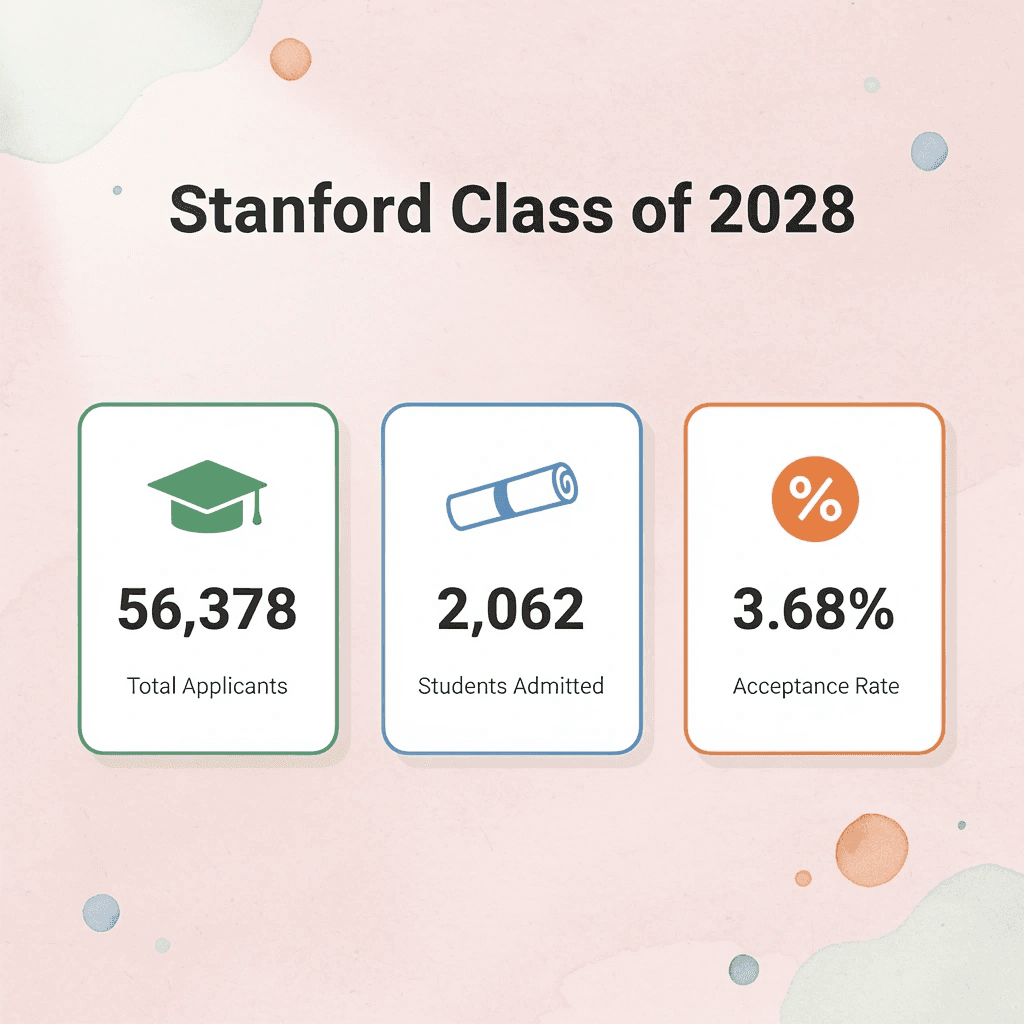
- Stanford admitted approximately 2,062 students out of 56,378 applicants for the Class of 2028, a 3.68% acceptance rate according to CollegeVine. At that level of selectivity, academic readiness functions as an entry fee rather than a competitive advantage. Stanford turns away applicants with perfect SAT scores not because they are unqualified, but because qualification and admission are two separate conversations at this scale.
- Admissions officers are building a class, not filtering a list, and what separates admitted students tends to be specificity rather than credential volume. A student who spent three years developing a water filtration system reads differently from a student who held leadership titles across five clubs, even if both share identical GPAs. Genuine investment in a specific pursuit, the kind that shows up in what a student actually built or changed over time, carries more weight than a stack of credentials designed to impress.
- Students who treat the application as a checklist tend to become invisible in the process. What admissions readers are searching for is evidence of something genuinely original, a story that would leave a visible gap if removed from the class. That shift from "Am I good enough?" to "What is genuinely mine to offer?" changes how an application gets built and what it ultimately communicates.
- Kollegio's AI college counselor addresses this by helping students map their full profile across every dimension of an application, not just their score, so they can identify and articulate what makes their candidacy specific and worth remembering.
Why Students Want to Know Stanford's SAT Requirements
Students searching for Stanford's SAT requirements are trying to answer a harder question: "Do I have a shot?"

That instinct makes sense. When every other part of an application feels subjective, a standardized test score offers something rare: a direct comparison. A student from a small town in Ghana and a student from a prep school in New Jersey can examine the same score range and ask the same question.
"When every other part of an application feels subjective, a standardized test score offers something rare: a direct comparison across vastly different backgrounds and schools." — NACAC
🎯 Key Point: The SAT is the only objective benchmark most students can measure themselves against in an otherwise deeply subjective process.
🔑 Takeaway: Students search for Stanford's SAT requirements, seeking clarity, context, and an honest answer to the question: Do I belong here?
What does Stanford's SAT score range actually tell applicants?
The worry behind that search makes sense. According to PrepScholar, Stanford's middle 50% SAT score range for admitted students is 1500–1570, with an average of 1540. When applicants see those numbers, the gap between their current scores and those of admitted students becomes tangible.
Most students focus on that range as if getting that score guarantees admission. A 1560 does not unlock Stanford the way a password unlocks a phone. What it does do is show that your academic preparation is part of the conversation. Students who treat the score as a finish line rather than one piece of a larger profile are most likely to be surprised by results. Platforms like Kollegio's AI college counselor exist because that focus is so common and costly: our AI college counselor helps students evaluate their full profile against thousands of data points instead of focusing on a single metric.
Why does Stanford's silence on a minimum score create confusion?
Stanford does not publish a minimum SAT cutoff, leaving applicants to fill that silence with assumptions. AdmitStudio reports that nearly all successful Stanford applicants score at or above the 98th percentile nationally, but even that benchmark does not tell the whole story. A student who scores in the 99th percentile with a weak application is no more competitive than a student with a 97th-percentile score and a genuinely distinctive profile.
The score matters, but not the way most students think it does.
What SAT Score Is Required for Stanford?
Stanford does not require a minimum SAT score. According to Stanford University Undergraduate Admission, the university is test-optional, meaning students can choose whether to submit scores.
"Stanford is test-optional, giving applicants full control over whether SAT scores become part of their application." — Stanford University Undergraduate Admission
💡 Tip: Submit your SAT score if it strengthens your application. If it doesn't reflect your full academic potential, you are not required to include it.

For students who do submit scores, admitted students who submitted SAT scores fell within a range of 1510 to 1570, according to Cosmic College Consulting's analysis of the Stanford Common Data Set 2024-2025. This range describes the middle 50% of admitted students who took the test — meaning a quarter scored below 1510 and a quarter scored above 1570.
SAT Score Range | What It Means |
|---|---|
Below 1510 | Bottom 25% of admitted score submitters |
1510 – 1570 | Middle 50% of admitted score submitters |
Above 1570 | Top 25% of admitted score submitters |
🔑 Takeaway: A score of 1570 or higher puts you in the top quarter of Stanford admits who submitted scores — but remember, test-optional means scores are one factor, not the deciding one.
⚠️ Warning: Don't assume hitting 1510 guarantees admission. Stanford's acceptance rate is extremely competitive, and SAT scores are just one piece of a holistic review process.
What a score in this range actually signals
A score between 1510 and 1570 clears Stanford's academic threshold but doesn't make you stand out. Students who understand this treat their SAT score as a floor: a baseline that allows the rest of their application to be taken seriously.
Why does a score in the middle 50% still lead to rejection?
The painful reality: applicants with scores well inside that range, sometimes a 1550, get rejected while students at the lower end gain admission. A score in the middle 50% means you look like most admitted students academically. It says nothing about whether your application tells a story worth remembering.
What do students risk by fixating on a higher score?
Students who focus too much on getting a 1570 often overlook what Stanford values equally: the specificity of their intellectual interests, the coherence of their activities, and their essay voice. Our AI college counselor at Kollegio helps students see their full profile as an admissions reader would, mapping strengths across every dimension rather than anchoring strategy to a single score.
Where the real leverage lives
Your SAT score gets you in the room. What you do with the rest of your application determines whether you leave with an offer. Students who treat 1510-1570 as the finish line are solving the wrong problem. Stanford seeks students who bring something specific, something that cannot be replicated by the next applicant in the pile. A near-perfect score with a generic profile is less compelling than a slightly lower score paired with genuinely original work. That gap between clearing the academic bar and standing out is where Stanford's admissions process becomes far more complicated than any score range can explain.
Related Reading
- What ACT Score Is Needed for Harvard
- Average Act Score For Nc State
- Average Sat Score For Unc
- Average Sat Score For Umd
- Average Sat Score For Uc Berkeley
- Average SAT Score for Virginia Tech
- Average Sat Score For Brown
- Average SAT Score for UVA
- Average SAT Score for Michigan
- Average Sat Score For Ohio State
How Competitive Is Stanford Admission?
Stanford admitted approximately 2,062 students out of 56,378 applicants for the Class of 2028, according to the CollegeVine Blog. With fifty-six thousand applicants competing for roughly two thousand seats, being academically ready is not what sets you apart from other applicants at this level — it is simply the basic requirement to be considered.
"With 56,378 applicants competing for 2,062 seats, academic readiness isn't a differentiator — it's the bare minimum to be in the room." — CollegeVine Blog
🔑 Takeaway: Stanford's acceptance rate hovers at a staggering ~3.7% — meaning more than 96 out of every 100 applicants are turned away, no matter how strong their academics.
Metric | Number |
|---|---|
Total Applicants | 56,378 |
Students Admitted | 2,062 |
Acceptance Rate | ~3.7% |
Applicants Rejected | 54,316+ |
Students often misunderstand what "competitive" means. They reach Stanford's admitted score range and assume the problem is solved. But a 1550 SAT score is common among Stanford applicants — not unusual. When thousands of applicants share your exact same score, it becomes background noise rather than a genuine reason for admission.
⚠️ Warning: Hitting Stanford's score range does not make you stand out — it simply means you've cleared the floor. Thousands of rejected applicants had the same numbers.
🎯 Key Point: At this level, test scores and GPA are table stakes. The real differentiator is everything beyond the numbers: your story, your impact, and your unique perspective.
What actually separates admitted students
The critical difference is specificity. Admissions officers are building a class where every admitted student brings something distinct—something that would leave a visible gap if removed. A student who spent three years developing a water filtration system for a rural community in Ghana reads differently from a student who joined five clubs and held leadership titles in each. Both may have identical GPAs. Only one has a story that is genuinely hard to replicate.
Why does stacking credentials create invisibility instead of distinction?
Most students approach Stanford's application as a checklist, stacking credentials and hoping volume creates distinction. The hidden cost is invisibility. When every line reads as designed to impress rather than reveal, admissions readers notice. They search for evidence of genuine investment: the kind of commitment that shows up in the details of what you built, changed, or pursued over time. Tools like Kollegio's AI college counselor help students identify and articulate those distinguishing qualities, treating a student's full profile as an asset.
The CollegeVine Blog reports a 3.68% acceptance rate for the Class of 2028. Stanford turns away students with perfect SAT scores every cycle, not because they're unqualified, but because qualification and admission are separate conversations at this level of selectivity. A perfect score confirms you can handle Stanford's coursework; it says almost nothing about whether you will shape the experience of students around you.
How does understanding curation versus filtering change how you apply?
Stanford's admissions process is less like a filter and more like curation. Filters remove what doesn't meet a standard; curation selects what fits a specific vision. Students who understand that distinction stop asking "Am I good enough?" and start asking "What is genuinely mine to offer?" That shift changes how an application gets built and what it communicates to readers.
Is Your SAT Score Competitive for Stanford?
Stanford's middle 50% SAT range for enrolled students is 1510–1570. Scores within or above this range match the academic profile of admitted students, while scores below this threshold may need exceptional strength elsewhere in the application.
"Stanford's middle 50% SAT range for enrolled students is 1510–1570 — meaning half of all admitted students scored above a 1570." — College Transitions
SAT Score Range | Competitiveness at Stanford |
|---|---|
1570–1600 | Highly competitive — above the middle 50% |
1510–1570 | Competitive — within the middle 50% range |
Below 1510 | Challenging — requires exceptional strength elsewhere |
🎯 Key Point: A score of 1510 or higher is essential to be considered academically competitive at Stanford — anything below puts significant pressure on the rest of your application.
🔑 Takeaway: The 1510–1570 range is not a guarantee of admission — it simply means your scores won't hold you back. Stanford's acceptance rate is under 4%, so every part of your application must be exceptional.
Is a 1400 SAT score competitive for Stanford?
A 1400 is an excellent score by national standards, placing students well above average test takers. However, it falls below Stanford's middle 50% range, so applicants would need exceptional strengths elsewhere: outstanding grades in rigorous coursework, significant extracurricular achievements, leadership experience, or compelling personal essays.
Is a 1500 SAT score competitive for Stanford?
A 1500 sits just below the 25th percentile, at 1510, and demonstrates strong academic ability among the highest-performing test-takers. However, Stanford's admissions process is highly selective. A 1500 may help an applicant remain academically competitive, but admission depends heavily on the overall strength of the application: academic achievements, extracurricular involvement, leadership, and personal impact.
Is a 1550+ SAT score competitive for Stanford?
A 1550+ score falls within Stanford's admitted student profile and is considered competitive, placing applicants near the top of the range of commonly reported scores. However, even a perfect 1600 does not guarantee admission. Stanford receives thousands of applications with similar scores every year, many of which are denied due to limited space.
Once an applicant reaches Stanford's competitive SAT range, differences of a few points matter far less than the rest of the application. A student with a 1550 and meaningful achievements outside the classroom is often more competitive than one with a slightly higher score but a less compelling overall profile. View SAT scores as one piece of the admissions puzzle rather than the sole determinant of your chances.
What Else Does Stanford Consider Besides SAT Scores?
While SAT scores show that you are ready for college-level work, Stanford looks at many different things when deciding whether to accept students. The school does not just look at test scores.
"Stanford's admissions process is holistic — test scores are just one piece of a much larger, more complex picture of who you are as a student and person." — Stanford Admissions
🎯 Key Point: Stanford uses a holistic admissions process, meaning every part of your application — from essays to extracurriculars — carries real weight in the decision.
💡 Tip: Don't let a single test score define your application. Stanford is evaluating your full potential, not just your academic metrics.
Factor | What Stanford Evaluates |
|---|---|
Academic Excellence | GPA, course rigor, class rank |
Test Scores | SAT, ACT, AP/IB results |
Essays | Personal insight, voice, storytelling |
Extracurriculars | Leadership, passion, impact |
Recommendations | Teacher and counselor perspectives |
Character | Intellectual curiosity, community contribution |

How do academic performance and course rigor factor into Stanford admissions?
Academic performance remains important. Stanford examines grades throughout high school, considering GPA, grade consistency, and performance in core subjects. How hard your courses are also matters. Admissions officers want to see students taking the most challenging courses available, such as AP, IB, honors, A-Level, or other advanced programs. Strong grades in rigorous courses often outweigh test scores alone.
What extracurricular and personal qualities does Stanford look for?
Beyond academics, Stanford values extracurricular achievements: leadership roles, research projects, community service, athletics, creative pursuits, and entrepreneurial ventures that distinguish applicants. Essays and recommendation letters provide insight into character, interests, motivations, and potential contributions to the Stanford community.
How does Stanford's holistic review affect your overall competitiveness?
Stanford uses holistic review, meaning no single factor determines admission. Academic achievements, personal qualities, extracurricular involvement, and overall fit are evaluated together. This creates a challenge for applicants. Even knowing how your SAT score compares to Stanford's admitted student range, determining your overall competitiveness requires evaluating your complete academic and extracurricular profile.
Related Reading
- What Sat Score Is Required For Uf
- Average Sat Score For Uga
- Average Act Score For Georgia Tech
- Northwestern Average SAT Score
- Average Sat Score For Georgetown
- Rice University Average Sat Score
- Caltech Average Sat Score
- What Is The Combined Essay Score For Sat
- What SAT Score Is Required for Cornell
How Kollegio Helps Students Evaluate Their Chances at Competitive Universities
After researching Stanford's SAT score range, students ask: "Am I competitive for admission?"
"SAT scores only tell part of the story. A student's grades, coursework, and extracurricular activities are equally critical factors in determining competitiveness." — Kollegio
🎯 Key Point: Knowing Stanford's SAT score range is the starting point. The real question is how your full profile stacks up against other applicants.

The challenge is that SAT scores only tell part of the story. A student may have a score within Stanford's admitted student range but be unsure how their grades, coursework, and extracurricular activities compare to those of other applicants. Another student may think they are not competitive because of a slightly lower score, even though other strengths could make them a strong candidate.
Profile Factor | Why It Matters |
|---|---|
SAT Score | Baseline academic benchmark |
GPA & Coursework | Demonstrates sustained academic rigor |
Extracurricular Activities | Shows unique strengths beyond the classroom |
💡 Tip: Don't let a single metric define your chances — holistic evaluation across all factors is what competitive admissions truly require.
🔑 Takeaway: A slightly lower SAT score does not automatically disqualify you — other strengths in your profile can make you a surprisingly strong candidate at even the most selective universities.
How does Kollegio go beyond SAT score comparisons?
Kollegio gives students personalized college guidance that goes beyond comparing SAT scores. Instead of focusing on a single metric, students can examine their overall academic profile to see how it aligns with what different universities seek. Using its university-matching tools, Kollegio helps students find schools that align with their academic background, interests, and goals, which is especially helpful when building a balanced college list that includes reach, target, and likely schools. Students can gain admissions insights into what universities seek beyond standardized test scores, helping them make informed decisions about where to apply and how to strengthen their applications.
What tools does Kollegio offer to assess a student's full profile?
Kollegio's academic profile evaluation tools assess student competitiveness by examining grades, academic achievements, and other application components, providing a more complete picture than SAT scores alone. The platform also supports application planning and helps students identify scholarship opportunities that align with their profiles and goals. Kollegio helps students understand that college admissions depend on more than a single test score. By providing data-driven insights and personalized guidance, the platform enables students to make smarter application decisions and focus their efforts where they have the best chance for success.
Use Kollegio's AI College Counselor for Free Today!
Knowing what to offer is one thing. Knowing how to present it, which schools fit your full profile, and where scholarship opportunities exist is where most students lose ground. That gap is an access problem.
"The difference between a strong application and a missed opportunity isn't talent — it's strategy, guidance, and access to the right information at the right time."
⚠️ Warning: Without personalized guidance, even the most qualified students risk applying to the wrong schools, missing scholarship opportunities, and leaving their strongest qualities unrepresented.

Kollegio's AI college counselor gives every student — regardless of zip code or budget — a personalized strategy that used to cost thousands of dollars. From essay feedback to activity framing to school matching built on real admissions data, it replaces guesswork with clarity. Try it free today and build an application that reflects who you actually are.
🎯 Key Point: Kollegio levels the playing field by delivering the kind of data-driven, personalized college strategy that was previously available only to students with access to expensive private counselors.
Feature | Traditional Counselor | Kollegio AI |
|---|---|---|
Cost | Thousands of dollars | Free to start |
Essay Feedback | ✅ Yes | ✅ Yes |
School Matching | Limited | Built on real admissions data |
Activity Framing | ✅ Yes | ✅ Yes |
Availability | Scheduled appointments | Anytime, anywhere |
Access | Zip code dependent | Every student |
💡 Tip: Start with Kollegio's free tier today — use the school matching tool and essay feedback features first to immediately strengthen the most critical parts of your application.
Related Reading
- What Is The Combined Essay Score For Sat
- What Act Score Is Needed For Alabama
- What Sat Score Is Required For Mit
- What Sat Score Is Required For Columbia
- What Sat Score Is Required For Notre Dame
- What Sat Score Is Required For Ucla
- What Sat Score Is Required For Texas A&m
- What Sat Score Is Required For Ut
- What Sat Score Is Required For Duke
- What Sat Score Is Required For Cornell
- What Sat Score Is Required For Nyu
- What Sat Score Is Required For Princeton
- What Sat Score Is Required For Yale
- What Sat Score Is Required For Harvard
- What Sat Score Is Required For Ivy League
Author
Trailblazer Marketing