
What SAT Score Is Required for Texas A&M? Improve Your Chances
Knowing the SAT score required for Texas A&M is one of the most practical steps a student can take early in the college planning process. Texas A&M is a competitive public university, and understanding the average scores, middle 50% ranges, and the admissions office's priorities helps students build stronger, more targeted applications. A clear benchmark also reveals whether a retake makes sense or whether other parts of the profile deserve more attention.
Reaching that benchmark takes more than picking a number out of thin air. Students need to know how their current scores compare to those of admitted applicants and what concrete steps can close the gap, whether that means additional test prep, a stronger GPA, or a more compelling personal statement. For personalized guidance through every part of that process, students can turn to an AI college counselor.
Table of Contents
- Why Students Ask: SAT Score Required for Texas A&M
- What SAT Score Is Required for Texas A&M?
- Is Your SAT Score Competitive for Texas A&M?
- What Other Factors Does Texas A&M Consider?
- Should You Retake the SAT for Texas A&M?
- How Kollegio Helps Students Build Stronger Texas A&M Applications
- Use Kollegio's AI College Counselor for Free Today!
Summary
- Texas A&M does not set a fixed SAT cutoff, but the middle 50% range for admitted students runs from 1210 to 1430, according to PrepScholar's admissions data. That spread matters more than any single target number because it shows where a score starts to feel competitive and where it begins to work against an applicant. A score below 1210 is not an automatic denial, but it places the rest of the application under more scrutiny.
- Test scores carry real weight, but they do not operate in isolation. Texas A&M uses a holistic review process, meaning GPA trajectory, course rigor, class rank, extracurriculars, and essays all factor into decisions alongside SAT results. According to GoodGoblin.ai, 91% of admitted students ranked in the top quarter of their high school class, which signals that consistent academic performance across years matters as much as a single strong test result.
- Course selection shapes how a GPA is read. A 3.7 earned through AP, IB, or dual-enrollment coursework signals something different than a 3.9 built on easier classes. GoodGoblin.ai reports that 66% of admitted students ranked in the top tenth of their high school class, suggesting that students who actively seek academic challenge tend to be more competitive than those who optimize for grades alone.
- Retaking the SAT makes sense under specific conditions, not as a default move. PrepScholar identifies the 25th percentile SAT score for admitted students at around 1160, placing that as a reasonable threshold below which additional preparation is worth the investment. Above that point, time spent on essays, activity descriptions, and coursework often produces a stronger return than chasing incremental score gains.
- Merit scholarships provide an additional reason to consider retaking, even for students who are already competitive for general admission. Texas A&M's acceptance rate sits near 63%, meaning admission itself is within reach for a wide range of applicants. But scholarship thresholds often exceed standard admissions benchmarks, making a retake financially meaningful for students who are close to a qualifying score.
- Essays are one part of the application where a student's voice appears unfiltered. Grades and scores are data points, but essay choices reveal self-awareness, values, and purpose in ways that no transcript can. A well-written essay can reframe an academic dip or add dimension to an otherwise flat profile, while a generic one can quietly weaken an application that looks strong on paper.
- Kollegio's AI college counselor addresses this by connecting a student's SAT scores, GPA, course rigor, and extracurricular record to real admissions data, giving a clearer picture of where the full application stands rather than leaving students to interpret score charts on their own.
Why Students Ask: SAT Score Required for Texas A&M
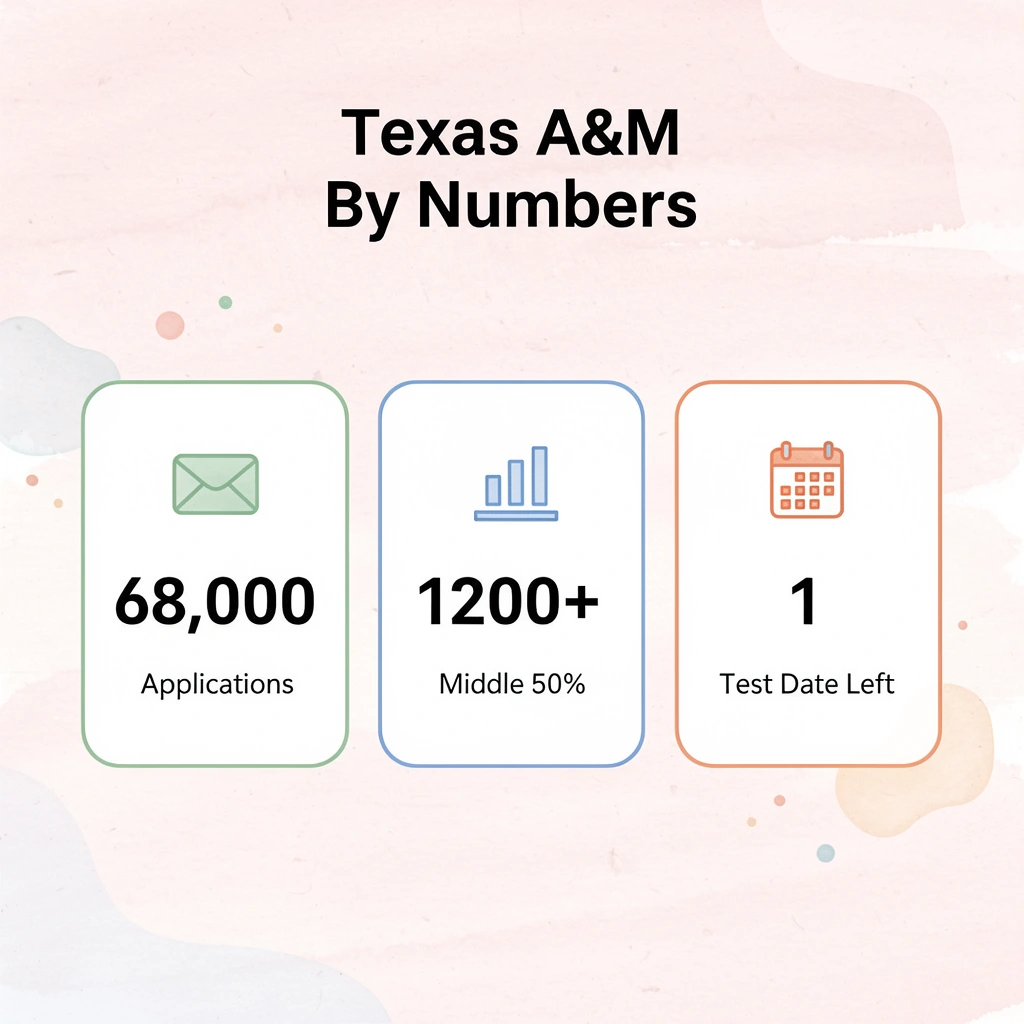
Every year, thousands of students search for a specific SAT score that will get them into Texas A&M. With a 68,000-application pool and the decision of whether to register for another test date, students need a number to aim for.
"With a 68,000-application pool, knowing your exact target score is essential for making smart decisions about test prep and retakes."
🎯 Key Point: Searching for a target SAT score is one of the most common steps students take when planning their Texas A&M application strategy.
💡 Tip: Don't search for a minimum score alone. Understand the full scoring range to position yourself as a competitive applicant in a pool of thousands.
Why does the SAT range matter more than a single cutoff score?
Looking for a single cutoff score often leads to the wrong answer. According to PrepScholar's Texas A&M SAT Scores and GPA data, the 25th percentile SAT score for admitted students is 1130, while the 75th percentile is 1390. This 260-point spread shows that Texas A&M admits students with a wide range of academic abilities; the significance of your score depends on where it falls within that range and what else is in your application.
How does a high SAT score function alongside the rest of your application?
A common pattern emerges among applicants with strong SAT scores but weaker GPAs: they treat a high test score as a counterweight, hoping it tips the balance in their favor. Texas A&M evaluates course rigor, class rank, leadership experience, and essay responses alongside test scores, so a 1400 SAT attached to a thin application tells a different story than the same score paired with a demanding transcript and genuine extracurricular depth.
Most students approach SAT targeting without understanding how that number functions in the larger admissions picture. Our Kollegio AI college counselor addresses this by connecting your SAT score to your full academic profile, showing you where your score lands relative to admitted students and how the rest of your application strengthens or weakens what that score signals to admissions officers.
When does your SAT score make retesting worth the investment?
Understanding the score range changes how students think about retaking the SAT. If your score falls below the 25th percentile, additional preparation is likely warranted. If you are within the middle 50%, your time may be better spent on essays, activity descriptions, or finding schools where your full profile is a stronger fit.
Related Reading
- What ACT Score Is Needed for Harvard
- Average Act Score For Nc State
- Average Sat Score For Unc
- Average Sat Score For Umd
- Average Sat Score For Uc Berkeley
- Average SAT Score for Virginia Tech
- Average Sat Score For Brown
- Average SAT Score for UVA
- Average SAT Score for Michigan
- Average Sat Score For Ohio State
What SAT Score Is Required for Texas A&M?
Texas A&M does not publish a fixed SAT cutoff. According to PrepScholar's Texas A&M admissions data, the middle 50% SAT range sits between 1210 and 1430. Your score relative to that range indicates where you stand, but it does not tell the whole story.
"The middle 50% SAT range for Texas A&M sits between 1210 and 1430 — meaning half of all admitted students scored within this window." — PrepScholar Admissions Data
🎯 Key Point: Scoring above 1430 puts you in the top 25% of admitted applicants, giving your application a significant competitive edge.
🔑 Takeaway: A score of 1210 is your baseline target, but aiming for 1430 or higher dramatically strengthens your overall admissions profile.

What the acceptance rate actually signals
Texas A&M's acceptance rate is around 63%, which may surprise students who view the school as a long shot. This reflects a university that admits a wide, diverse class rather than a small elite group. However, a wider acceptance rate does not mean easier admission. With tens of thousands of applicants competing for spots, the difference between admitted and denied students often hinges on application elements that test scores cannot capture.
Why one number misleads more than it helps
Students often focus too much on hitting a target SAT score, treating everything else as secondary. A student who scores 1420 but submits weak activity descriptions and a generic essay is not more competitive than a student at 1300 with a clear academic trajectory, meaningful leadership, and a compelling personal story. Texas A&M's holistic review is not a nice gesture: it is how decisions get made.
How does your full profile fit together as a coherent whole?
Most students approach admissions like a checklist: hit the GPA threshold, hit the SAT range, submit, and wait. What gets lost is the connective tissue—understanding how each piece of your profile speaks to the others and whether your application reads as a coherent whole. An AI college counselor like Kollegio connects those data points across your full profile, helping you see not just where your score lands, but how it fits within everything else you bring to the table.
When your score falls outside the middle range
Knowing where your score lands is only the starting point. What separates applicants who use that information well from those who do not is something most score guides never explain.
Does a below-range SAT score disqualify you from Texas A&M?
If your SAT score is below 1210, you can still gain admission. Students with lower scores have been admitted to Texas A&M when the rest of their application demonstrates academic commitment and potential contributions. A low score paired with improving grades, challenging coursework, and strong recommendations tells a different story than a low score standing alone. Context matters as much as the score itself.
Can a high SAT score above the 75th percentile still lead to denial?
Scores above 1430 carry a false belief. Students who score above the 75th percentile often think the hard work is finished. Many applicants with high SAT scores are still rejected each year because a strong test result, without the rest of the application matching that strength, does not help in the way students expect.
Is Your SAT Score Competitive for Texas A&M?
Your SAT score tells one part of the story—whether it's competitive depends on the full picture.
🎯 Key Point: Your SAT score is never evaluated in isolation; it's one signal in a much larger admissions picture.
"The middle 50% SAT range for Texas A&M is 1200–1430 — meaning half of all admitted students scored within this window." — PrepScholar Texas A&M Admissions Data
According to PrepScholar's Texas A&M admissions data, the middle 50% SAT range for Texas A&M is 1200–1430. A score of 1350 puts you comfortably inside it; 1180 puts you near the lower edge. Neither is a final decision, but both show where you stand before the rest of your application.
🔑 Takeaway: Knowing exactly where your score lands in the 1200–1430 range is essential — a 1350 and a 1200 tell very different stories to admissions officers, even though both fall inside the window.

What the numbers actually signal
A 1300 paired with a 4.2 weighted GPA, AP coursework in three subject areas, and a consistent upward academic trend reads differently than a 1300 next to a 2.8 GPA and a transcript that plateaued sophomore year. Admissions officers read trajectories. A pattern of improvement over time, even from a difficult starting point, carries more weight than a static number.
Can a strong SAT score compensate for a lower GPA?
Many applicants focus too much on the SAT as the one thing they can control. Students who struggled in ninth and tenth grade often hope a strong SAT score can compensate for a cumulative GPA that no longer reflects who they are. A high SAT score does strengthen your application, but it cannot change your academic record. What it can do is demonstrate readiness, especially when you have taken challenging classes and your grades improved in junior year.
Why does comparing yourself to admitted students miss the full picture?
Most students research score ranges and compare themselves to admitted students, but this approach ignores how their specific combination of GPA, course load, and extracurricular involvement compares to others in their applicant pool. An AI college counselor like Kollegio connects those data points, giving you a clearer picture of where your full profile stands rather than leaving you to decipher score charts on your own.
Where the 75th percentile creates a false ceiling
CollegeTuitionCompare reports that Texas A&M's SAT Evidence-Based Reading range is 580 to 690, with Math 570 to 710, among enrolled students. Scoring above those top scores doesn't guarantee admission: it places you in a smaller group that still competes on a whole-person basis. High scores serve as strong evidence, not permission to weaken other parts of your application.
What does Texas A&M actually evaluate beyond your score?
Scores matter. Course rigor matters. GPA consistency matters. But Texas A&M ultimately asks whether you'll succeed there—a question answered by your full application, not a single number.
Once you understand what a competitive SAT score buys you, the next question becomes more interesting.
Related Reading
- What Sat Score Is Required For Uf
- Average Sat Score For Uga
- Average Act Score For Georgia Tech
- Northwestern Average SAT Score
- Average Sat Score For Georgetown
- Rice University Average Sat Score
- Caltech Average Sat Score
- What Is The Combined Essay Score For Sat
- What SAT Score Is Required for Cornell
What Other Factors Does Texas A&M Consider?
Texas A&M looks at a wide range of factors beyond just test scores — including your GPA, course rigor, class rank, extracurricular activities, leadership skills, community service, and application essays as part of a holistic review process.
"Admissions at Texas A&M is not a single-metric decision — factors like leadership, community involvement, and essay quality all play a meaningful role alongside academic performance." — Texas A&M Admissions Overview
🎯 Key Point: Texas A&M uses a holistic admissions approach — meaning no single factor makes or breaks your application. Strength across multiple areas is what sets competitive applicants apart.
💡 Tip: Don't overlook your application essays — they are one of the few places where you can directly showcase your personality, leadership narrative, and unique experiences to admissions reviewers.
How class rank and GPA shape your profile
Your GPA shows admissions officers how consistently you performed, while your class rank shows how that performance compares to peers in your classroom. According to GoodGoblin.ai's 2025 Texas A&M admission statistics, 91% of admitted students ranked in the top quarter of their high school class. A strong SAT score paired with average class rank sends a mixed signal; consistent academic performance sustained across years and subjects sends a clear one.
Why does course selection matter more than most students expect?
A 3.9 GPA in easy courses differs significantly from a 3.7 GPA earned through AP, IB, or dual-enrollment work. Admissions officers distinguish between them. GoodGoblin.ai reports that 66% of admitted students ranked in the top tenth of their high school class, demonstrating that students who pursue rigorous coursework get admitted.
Why is admissions a persuasion challenge rather than a math problem?
Most students build college lists by checking score ranges and hoping numbers match up. This treats admissions like a math problem when it's about persuading the college. Every part—essays, activities, service, leadership—shows why you belong there. Platforms like AI college counselor connect information across your full profile to find where your arguments are strong and where they need work. Kollegio provides personalized feedback that once cost $10,000 from a private counselor.
What leadership and service actually signal
Leadership doesn't require a title. Admissions officers look for evidence that you take initiative, follow through, and contribute beyond yourself. A student who organized a neighborhood food drive, coached younger athletes, or built a club from scratch demonstrates these qualities as clearly as any elected officer. Genuine, sustained commitment to a cause carries more weight than a padded list of one-time volunteer hours. Admissions officers trust depth over breadth.
Why essays carry more weight than students realize
Your essays are the only place in the application where your voice shows up unfiltered. Grades and scores are numbers; essays are decisions. What you choose to write about and how honestly you write it tell admissions officers something no transcript can. A well-written essay can reframe a bad grade, explain a nontraditional background, or reveal self-awareness that makes an applicant memorable. Weak essays can quietly undermine an otherwise strong application.
The next question almost every student asks is both obvious and surprisingly complicated.
Should You Retake the SAT for Texas A&M?
Retaking the SAT for Texas A&M makes sense under one critical condition: your score falls below the 25th percentile of 1160. According to Test Ninjas, students at this level should seriously think about retaking the test to improve their chances of getting admitted. Above it, the situation changes entirely.
"Students scoring below the 25th percentile of 1160 should think about retaking to improve their chances of getting admitted." — Test Ninjas
🎯 Key Point: The 1160 threshold is your decision line — fall below it, and a retake is essential for a competitive application.
⚠️ Warning: Don't assume a higher score always helps — if you're already above the 25th percentile, the return on retaking may be far smaller than you expect.
🔑 Takeaway: The 1160 cutoff is the single most important number to know — it's the line between a competitive application and one that may need significant support from other factors.

Does retaking the SAT actually strengthen your overall application?
The pattern among applicants is clear: students with competitive scores spend weeks on SAT prep while their GPA drifts, extracurricular commitments thin, and essays remain unfinished. A 30-point SAT gain rarely compensates for a semester of distraction. The application is a portfolio, and weakening three components to strengthen one is rarely a sound trade.
If your goal is a competitive engineering major, understand that the Engineering Transfer Admission Model (ETAM) is a separate, GPA-driven process determining entry into specific programs after your first year. Students investing energy into SAT prep, believing it unlocks Mechanical Engineering, are solving the wrong problem. ETAM rewards academic performance in college-level coursework, not high school test scores.
Ask yourself: "What would move the needle on my application right now?" rather than "Will a higher score help?" Our AI college counselor at Kollegio can map your full profile against Texas A&M's admitted-student data to identify your strongest components and gaps.
When does retaking the SAT make financial sense for Texas A&M?
Taking the test again makes more sense for scholarships than for admission. PrepScholar reports that Texas A&M's acceptance rate is approximately 63%, making admission within reach for many students. Merit scholarships often carry higher score thresholds than standard admissions benchmarks. If a retake pushes you past a scholarship cutoff, that represents a financially meaningful reason to prepare again.
Most competitive applicants gain more by investing their remaining time in coursework, leadership, and essays than in another SAT round. Retake the test only if you have a clear, realistic score target, sufficient preparation time, and a specific reason—scholarship eligibility or a score meaningfully below the admitted range—that justifies the effort.
How Kollegio Helps Students Build Stronger Texas A&M Applications
Texas A&M's SAT score range is one factor that makes an applicant truly competitive. Kollegio helps students understand that test scores alone don't tell the full story. Building a stronger application means addressing every dimension of what admissions officers evaluate.
"A standout Texas A&M application requires more than a target SAT score — it demands a complete, strategic profile built across academics, leadership, and character." — Kollegio Admissions Framework
💡 Tip: Don't let a strong SAT score give you false confidence. Texas A&M reviews the entire applicant, not a single number.

Texas A&M uses holistic admissions, looking at GPA, course difficulty, class rank, extracurricular activities, leadership experience, community involvement, and application responses — along with test scores. Students need a complete strategy, not just a target score. Kollegio is built to help students strengthen every one of these pillars simultaneously.
🎯 Key Point: Texas A&M's holistic review process means every section of your application is an opportunity — and a weak link anywhere can cost you.
✅ Best Practice: Use Kollegio to audit your entire application profile — not just your test prep — so no admissions factor is left underdeveloped.
How does Kollegio support a personalized application strategy?
Kollegio provides personalized college guidance based on students' academic profiles, interests, and goals. Rather than focusing solely on standardized test scores, our AI college counselor helps students understand how different application components contribute to overall competitiveness.
The platform's university matching tools help students find schools that match their academic background and discover additional universities that may be strong academic and personal matches.
Kollegio provides admissions insights and planning tools that help students navigate deadlines and make informed decisions throughout the application process.
How does Kollegio help students evaluate and strengthen their profile?
The platform helps students develop their application strategy by assessing their profile strengths and weaknesses, then identifying ways to improve their academics, extracurricular activities, leadership experience, and college list.
For students worried about paying for college, Kollegio helps them find scholarship opportunities that match their qualifications and goals.
Kollegio helps students assess their entire academic profile against specific universities, giving them a clear picture of their competitiveness beyond test scores alone.
How does Kollegio improve overall admissions outcomes?
Universities seek students who demonstrate readiness for college work, commitment to their goals, leadership ability, and potential for success. By evaluating all aspects of an application, Kollegio helps students build more competitive applications.
The platform helps students build balanced college lists that include reach, target, and likely schools, increasing their chances of acceptance while ensuring the options align with their abilities and goals.
Use Kollegio's AI College Counselor for Free Today!
That critical decision—whether your SAT score is strong enough, whether to retake, and how it fits your full application—is where students lose time and confidence without proper guidance.
"The difference between a guessed strategy and a data-backed one can mean the difference between acceptance and rejection at your target school." — Kollegio Admissions Insights
⚠️ Warning: Without personalized guidance, students misread their own competitiveness, wasting months on the wrong schools or underselling themselves to the right ones.
💡 Tip: You don't need to spend thousands of dollars on a private counselor to get expert-level admissions clarity—Kollegio's AI college counselor gives you that power for free.
Our AI college counselor at Kollegio provides that clarity for free. It connects your test scores, GPA, course rigor, and extracurriculars to real admissions data, so you can see exactly where you stand at Texas A&M and similar schools—without guessing. Students from California to Ghana are using it to build smarter applications, find scholarships, and get essay feedback that traditionally costs thousands of dollars. Start today at Kollegio and turn your profile into a working strategy.
🎯 Key Point: Kollegio replaces expensive guesswork with a data-driven admissions strategy—completely free and accessible to students anywhere in the world.
Related Reading
- What Sat Score Is Required For Ut
- What Sat Score Is Required For Nyu
- What Sat Score Is Required For Ivy League
- What SAT Score Is Required for Duke
- What Sat Score Is Required For Mit
- What Sat Score Is Required For Harvard
- What Sat Score Is Required For Cornell
- What Sat Score Is Required For Princeton
- What Sat Score Is Required For Stanford
- What Act Score Is Needed For Alabama
- What Sat Score Is Required For Ucla
- What Sat Score Is Required For Notre Dame
- What Is The Combined Essay Score For Sat
- What Sat Score Is Required For Columbia
- What Sat Score Is Required For Yale

Author
Senan KhawajaSenan Khawaja is the Co-Founder and CEO of Kollegio, an AI-native college counseling and institutional recruiting platform serving roughly 250,000 students across 190 countries. A Stanford graduate, repeat founder, and Forbes 30 Under 30 honoree with World Bank experience, Senan launched Kollegio to democratize elite college counseling—addressing the 400:1 student-to-counselor ratio in public schools. Under his leadership, Kollegio has secured 22+ institutional partners with a 100% renewal rate and backing from Reach Capital, JFF Ventures, and ECMC Group. He was also selected for OpenAI's inaugural ChatGPT Futures Class of 2026. Senan is based in New York City.