
What SAT Score Is Required for UCLA? Here's What Matters More
Getting into UCLA is one of the most competitive challenges in college admissions, and knowing what SAT score to aim for gives applicants a meaningful edge in planning. Understanding the score range UCLA actually considers, alongside what the admissions committee weighs beyond the numbers, helps students build a stronger, more focused application.
For students who want guidance that goes beyond benchmarks, Kollegio's AI college counselor can help identify where a score falls, what gaps need to be closed, and how to shape an application that reflects genuine strengths.
Table of Contents
- The Surprising Truth: UCLA Does Not Require SAT Scores
- If SAT Scores Don't Matter, What Does UCLA Actually Look For?
- Why Strong Students Still Get Rejected From UCLA
- The Four Parts of a UCLA Application That Carry the Most Weight
- What Students Should Focus on Instead of Chasing an SAT Target
- How Kollegio Helps Students Build Stronger UCLA Applications
- Use Kollegio's AI College Counselor for Free Today!
Summary
- UCLA's test-free policy is permanent, not a holdover from pandemic-era accommodations. The University of California Board of Regents unanimously approved a test-blind model across the entire UC system, meaning admissions officers at UCLA are not permitted to factor SAT or ACT scores into decisions even if a student submits them. Students who spend months chasing a score target for UCLA are optimizing for a criterion that carries zero weight in the review process.
- The academic bar at UCLA is high and consistent, but it functions as an entry fee rather than a differentiator. The middle 50% of admitted students carry a weighted GPA between 4.27 and 4.68, with unweighted GPAs ranging from 3.92 to 4.00. When tens of thousands of applicants clear that threshold, grades stop separating candidates, and everything built around them takes over.
- Course rigor carries more signal than GPA alone. Admissions readers evaluate a transcript against the context of what each school offers, meaning a student who earns a B in AP Chemistry often presents a stronger academic case than one who earns an A in a standard course. A slightly imperfect record in genuinely challenging coursework typically reads as better preparation than a flawless record built on lighter options.
- The Personal Insight Questions are the primary place in a UCLA application where a student's thinking, not their record, takes center stage. Strong responses do not catalog accomplishments. They reveal how a student processed an experience, what shifted in their thinking, and what they actually learned. Authentic reflection is rare in a pool of high achievers performing for an audience, and admissions officers notice the difference quickly.
- Extracurricular depth outweighs breadth in UCLA's review process. Admissions officers are not counting activities. They are reading for commitment, initiative, and sustained impact. A student who spent three years developing a tutoring program that grew from five students to fifty demonstrates more about their character and judgment than one who joined twelve clubs for a semester each.
- Context shapes how achievement is read. A 3.95 GPA earned while working 25 hours a week to support a family carries a different meaning than the same GPA earned with every resource available. UCLA's holistic review is specifically designed to surface that kind of context, and students who leave that information blank let their numbers speak alone when the full story would have been more compelling.
- Kollegio's AI college counselor addresses the gap between knowing what UCLA evaluates and building an application that communicates it clearly, offering essay feedback, activity evaluation, and college matching grounded in admissions data rather than guesswork.
The Surprising Truth: UCLA Does Not Require SAT Scores
UCLA does not require SAT or ACT scores for admission. According to UCLA Undergraduate Admission's First-Year Requirements, test scores are not considered in admissions decisions, even if submitted. This is a permanent policy, not a temporary pandemic-related change.
"Test scores are not considered in admissions decisions at all, even if submitted." — UCLA Undergraduate Admission's First-Year Requirements
🚨 Warning: Many applicants spend hundreds of hours and significant money preparing for a test that UCLA will not review. Don't waste your effort.

Most students build their college prep strategy around a score target, treating the SAT as a required ticket. At UCLA, this approach does not apply. Chasing a UCLA SAT score range is like training for a canceled race — wasted effort that could be better spent strengthening the factors UCLA actually evaluates in your application.
🔑 Takeaway: Your time and energy are better spent strengthening your GPA, personal insight essays, and extracurricular profile — the elements UCLA actually prioritizes.
✅ Best Practice: Redirect every hour of SAT prep into crafting a stronger application narrative that addresses what UCLA admissions officers seek.
Why do outdated SAT score ranges for UCLA still circulate?
Many students find old score ranges on third-party websites that show historical data from students who took the SAT, not a benchmark UCLA uses to evaluate applicants. Working toward such a score is misdirection, not preparation. When the University of California Board of Regents unanimously approved changes to standardized testing requirements, the entire UC system moved to a test-free model. Students can now redirect preparation time toward application elements that matter most. Our Kollegio AI college counselor helps students map their profiles against each school's evaluation criteria.
What is the difference between test-optional and test-free at UCLA?
The critical difference: at test-optional schools, a strong score can help. At test-free schools like UCLA, submitting any score changes nothing because admissions officers cannot factor it in. The competitive edge students once sought through standardized testing must come from elsewhere. So what is UCLA weighing? The answer is more specific and demanding than most students expect.
Related Reading
- What ACT Score Is Needed for Harvard
- Average Act Score For Nc State
- Average Sat Score For Unc
- Average Sat Score For Umd
- Average Sat Score For Uc Berkeley
- Average SAT Score for Virginia Tech
- Average Sat Score For Brown
- Average SAT Score for UVA
- Average SAT Score for Michigan
- Average Sat Score For Ohio State
If SAT Scores Don't Matter, What Does UCLA Actually Look For?
UCLA looks at 14 different factors when reviewing applications in a holistic way. According to the College Admissions Experts Facebook Group, UCLA specifically considers AP and IB exam scores while not looking at SAT and ACT results. This difference is critical: standardized test scores don't matter, but showing strong academics through advanced classes still matters a lot.
"UCLA specifically considers AP and IB exam scores while not looking at SAT and ACT results — showing that how you challenge yourself academically carries far more weight than a single test day." — College Admissions Experts Facebook Group
🔑 Takeaway: UCLA's holistic review spans 14 distinct factors — meaning no single number defines your application, but advanced coursework performance remains an essential signal of academic readiness.
💡 Tip: If you're aiming for UCLA, prioritize scoring well on AP and IB exams over obsessing about your SAT or ACT score — those scores are invisible to UCLA's admissions readers.
Test Type | Does UCLA Consider It? |
|---|---|
SAT | ❌ Not considered |
ACT | ❌ Not considered |
AP Exam Scores | ✅ Actively reviewed |
IB Exam Scores | ✅ Actively reviewed |

What the numbers actually show
The competitive reality is clear. Test Ninjas reports that UCLA received over 145,000 applications for fall 2023 with a 9% acceptance rate. The middle 50% of admitted students had weighted GPAs between 4.20 and 4.30, with a median of 4.61. Grades are the starting point; what separates applicants is everything built around them.
Does course rigor matter more than a perfect GPA?
Course rigor signals readiness, not ambition alone. A B in AP Chemistry communicates a different level of preparation than an A in standard Chemistry. Admissions officers evaluate transcripts against what each school offers. A slightly imperfect record in genuinely challenging courses often reads stronger than a flawless record in unchallenging ones.
What does UCLA actually look for in extracurriculars?
Most students approach extracurriculars like a resume: more entries feel like more evidence. UCLA reads for depth, commitment, and impact instead. A student who spent three years building a tutoring program for underserved peers tells a more compelling story than one who joined eight clubs for a semester each.
Why do the Personal Insight Questions carry so much weight?
The Personal Insight Questions are more important than many applicants realize. Unlike extra essays at private universities, the PIQs are UCLA's main way to learn who a student is beyond their grades. The strongest answers show how a student thinks, what matters to them, and how they have grown through specific experiences, not lists of accomplishments. This self-awareness is hard to fake, which is why students who think carefully about their answers tend to do better than those who write what they think admissions officers want to hear. Platforms like Kollegio provide organized, personalized feedback on this kind of writing: the type of help that once cost $10,000 from a private counselor but should be available to every applicant regardless of location.
What ties it all together
UCLA reads for a person, not a profile. Academic achievement, course selection, personal insight, extracurricular depth, community contribution, and intellectual curiosity all feed into one central question: will this student add something meaningful to the campus? No single element answers that alone.
Even students who check every box still receive rejection letters.
Why Strong Students Still Get Rejected From UCLA
Knowing what UCLA values doesn't explain why students with 4.3 GPAs, rigorous course loads, and strong extracurriculars still get rejected. That gap between qualification and admission catches most applicants off guard.
⚠️ Warning: Meeting UCLA's academic benchmarks does not guarantee admission — thousands of equally qualified students compete for the same spots.

"A 4.3 GPA with AP classes resulted in rejection from UCLA. Academic excellence is the starting point of the competition, not the highest point." — Parents of Class of 2026 Facebook Group
According to the Parents of the Class of 2026 Facebook Group, a 4.3 GPA with AP classes resulted in rejection from UCLA. Academic excellence is the starting point of the competition, not the highest point. When your pool contains tens of thousands of students who all meet that starting point, grades stop being what sets you apart and become a basic expectation.
🔑 Takeaway: At UCLA, a 4.3 GPA makes you eligible — it does not make you exceptional. The real competition begins after you clear the academic bar.
What Grades Do | What Grades Don't Do |
|---|---|
Make you eligible to apply | Differentiate yourself from the pool |
Signal academic readiness | Guarantee admission |
Meet the baseline expectation | Replace the need for a compelling story |
Show rigor and consistency | Compensate for a weak personal insight |
What actually separates similar applicants?
The failure point is usually not what a student achieved, but how clearly the application communicates who that student is as a person. A transcript full of A's in hard classes tells admissions readers a student can handle college coursework, but not what that student would bring to a seminar, research lab, or campus community. The applications that advance answer that second question with specificity and honesty, not with a list of accomplishments.
Why does authentic reflection matter more than a list of wins?
Most students approach their Personal Insight Questions like a resume, listing accomplishments rather than showing how they think. Real reflection is rare among high achievers performing for an audience. The students who stand out write about a moment that changed their perspective, a tension they navigated, or a failure from which they learned.
Students working alone often rely on guessing or copying what worked in someone else's acceptance story—approaches that rarely translate. Our AI college counselor at Kollegio uses thousands of data points to provide personalized feedback on essays and activity descriptions, helping students reveal what is distinctive about their story rather than defaulting to what sounds impressive.
Do strong credentials guarantee admission to UCLA?
College Confidential Forums show an applicant with a 32 ACT composite and a 3.89 GPA who was rejected. UCLA prioritizes well-rounded students over those with the highest grades and test scores. Strong academics get you considered; everything else determines admission.
The Four Parts of a UCLA Application That Carry the Most Weight
Academic achievement sets the floor. Everything built on top of it determines the ceiling. According to GoodGoblin.ai's UCLA 2025 Admission Statistics, the middle 50% of admitted students have a weighted GPA between 4.27 and 4.68, with unweighted GPAs ranging from 3.92 to 4.00. The academic bar is high and consistent, but it is the entry fee, not the finish line. What separates admitted students from rejected ones with nearly identical transcripts comes down to three other dimensions, each carrying real weight in the review room.
"The middle 50% of admitted UCLA students carry a weighted GPA between 4.27 and 4.68 — meaning a perfect 4.0 unweighted is the floor, not the ceiling." — GoodGoblin.ai, UCLA 2025 Admission Statistics
Application Dimension | What It Signals | Weight in Review |
|---|---|---|
Weighted GPA (4.27–4.68) | Academic rigor and consistency | Entry requirement |
Personal Insight Questions | Voice, resilience, and identity | High |
Extracurricular Activities | Depth of commitment and impact | High |
Course Rigor | Willingness to challenge yourself | High |
🎯 Key Point: A strong GPA is necessary but not sufficient — UCLA's review process is designed to find students who excel beyond the transcript.
🔑 Takeaway: With unweighted GPAs clustering between 3.92 and 4.00 among admitted students, the real differentiator is what you bring to the three non-academic dimensions that reviewers weigh just as heavily.

What the transcript actually signals
Admissions readers evaluate your GPA based on the coursework you have completed. A student taking every AP and honors course offered, earning mostly A's, and showing an upward trend presents a stronger case than one with a higher GPA from easier courses. Course rigor is assessed within your school's context: a student from a rural school with limited AP offerings isn't penalized for the lack of available options. The question is whether you challenged yourself as much as your environment allowed.
Where your voice actually enters the room
The Personal Insight Questions are the only place in a UCLA application where your thinking, not your record, takes center stage. Strong responses show how you processed an experience, what shifted in you, and why it matters now. A student who writes about a failed science project and what it taught them about intellectual humility will often leave a stronger impression than one who lists awards. The PIQs are where a transcript becomes a person.
Most students approach PIQs like a resume, cataloging accomplishments and hoping the list speaks for itself. This approach flattens the qualities UCLA seeks. Our AI college counselor provides specific feedback on whether responses are reflective or descriptive, helping close the gap between what students intend to say and what readers receive, without the $10,000 price tag that guidance usually carries.
What do extracurriculars reveal that grades cannot?
Extracurricular involvement answers a question your transcript cannot: what do you care about? Admissions officers seek commitment, initiative, and impact from sustained effort. A student who spent three years building a peer tutoring program that grew from five to fifty students demonstrates more character than someone who joined twelve clubs for a semester each. Cosmic College Consulting's analysis of UCLA's Common Data Set confirms that UCLA is test-blind, meaning the weight previously given to SAT scores is redistributed across these qualitative dimensions, making depth of involvement more consequential than most applicants realize.
Why does context matter more than most applicants realize?
Context is the fourth pillar and the most underestimated. UCLA's holistic review examines what an achievement cost a student, not what it produced. A 3.95 GPA earned while working 25 hours a week to support a family differs significantly from the same GPA earned with every resource available. Admissions officers are trained to read for this, and the application provides space to share it. Students who leave that context blank let their numbers speak alone, when the full story would be far more compelling. Knowing which of these four dimensions is your weakest and fixing it before you submit changes the outcome more than almost anything else you can do.
Related Reading
- What Sat Score Is Required For Uf
- Average Sat Score For Uga
- Average Act Score For Georgia Tech
- Northwestern Average SAT Score
- Average Sat Score For Georgetown
- Rice University Average Sat Score
- Caltech Average Sat Score
- What Is The Combined Essay Score For Sat
- What SAT Score Is Required for Cornell
What Students Should Focus on Instead of Chasing an SAT Target
Fixing your weakest area before submitting is the right instinct. But knowing which area to fix and how to fix it efficiently is where most students get stuck.
💡 Tip: Work on the right thing. Identifying your highest-leverage weakness is the first and most critical step toward meaningful score improvement.

"The gap between students with expert guidance and those without is not a talent gap or an effort gap — it is an information gap, and it changes outcomes in ways that feel invisible until a rejection letter arrives."
Time is the most unequally distributed resource in college admissions. Students with expensive private counselors spend months testing every part of their application profile. Everyone else guesses. That gap is not a talent gap or an effort gap. It is an information gap, and it changes outcomes in ways that feel invisible — until a rejection letter arrives.
⚠️ Warning: Without a clear, data-driven strategy, students risk spending precious time improving areas that won't meaningfully move the needle on their final admissions outcome.
Student Type | Guidance Available | Typical Outcome |
|---|---|---|
Private counseling | Months of personalized profiling | Targeted, efficient application strategy |
Self-guided | Trial and error | Inconsistent, high-risk decisions |
AI-assisted | On-demand, data-backed insight | Informed choices without the premium cost |
Does depth in your activity list matter more than breadth?
The failure point is usually specificity. Students strengthen their activity list by adding more activities, when the real move is deepening the ones already there. A student who spent two years building a tutoring program, tracking student progress, and expanding it to three schools tells a fundamentally different story from one who lists twelve clubs with no arc. One well-developed commitment with measurable impact outweighs a crowded resume every time.
Course rigor follows the same logic. The question is not whether you took AP courses, but whether you challenged yourself relative to what your school offered. According to Capstone Education Consulting, students should set a goal score 50 to 200 points higher than their diagnostic baseline when preparing for standardized tests. Apply this principle to academics: stretch beyond your current floor; do not coast at it.
How does fragmented planning hurt your application?
Most students plan their college applications through Google searches, school counselor meetings, and last-minute guesses. This fragments the process when seeing your complete profile matters most. An AI college counselor like Kollegio solves this directly. Our platform provides personalized college recommendations, activity feedback, essay review, and scholarship matching in one place.
Why do your Personal Insight Questions deserve more preparation time?
The Personal Insight Questions deserve more preparation time than most students allocate. The College Board's 2025 SAT Suite of Assessments Annual Report found that only 39% of SAT takers in the class of 2025 met or exceeded both the Reading and Writing and Math college readiness benchmarks, down from 45% in the class of 2019. Strong written communication is increasingly rare, so a student who writes with clarity, specificity, and genuine self-awareness stands out more today than five years ago. Your PIQs are not a summary of your resume; they are where your voice, reasoning, and perspective exist on their own terms.
How Kollegio Helps Students Build Stronger UCLA Applications
Turning a strong profile into an actual offer means showing those strengths in a clear, consistent, and timely way. Most applicants lose ground in this execution gap: not because they lack qualifications, but because they fail to translate those qualifications into a polished, cohesive application.
🎯 Key Point: A strong profile means nothing if it isn't communicated with clarity and consistency at every stage of the application.
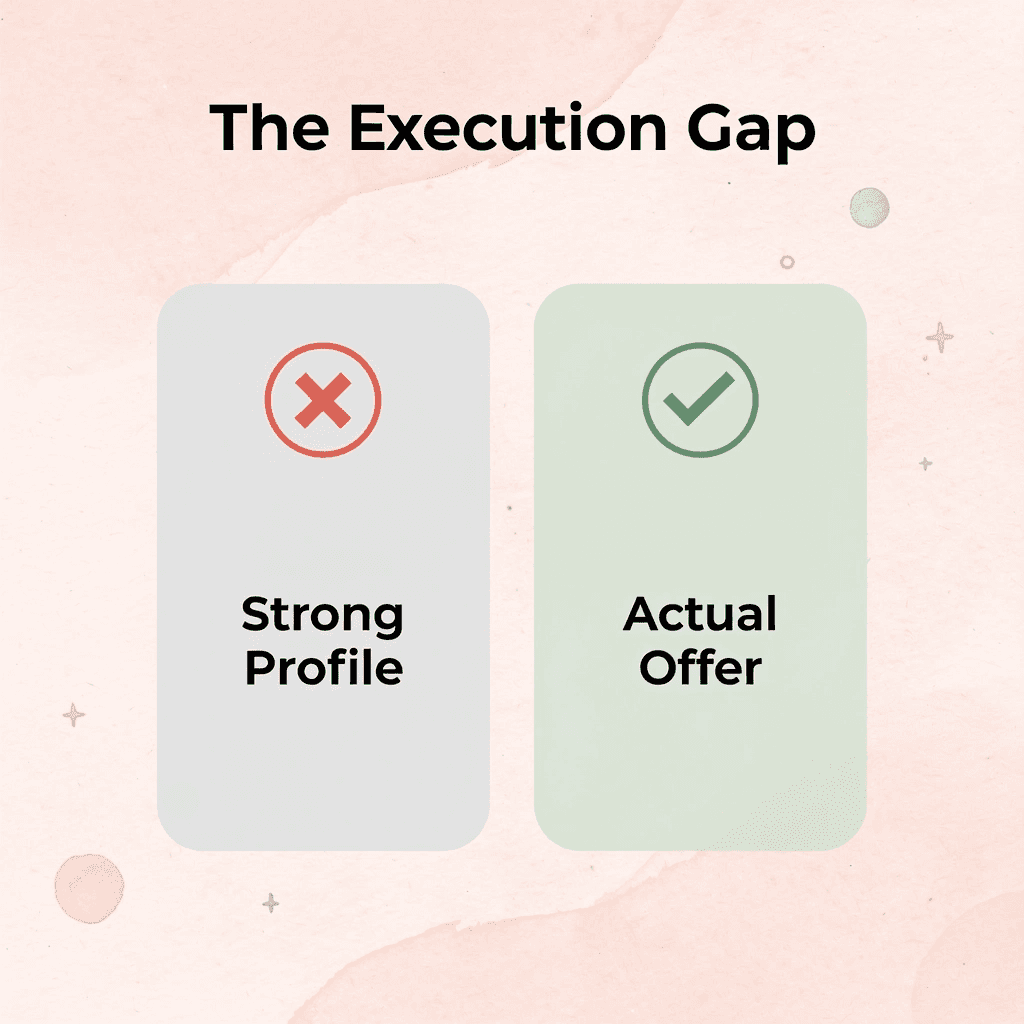
Most students approach this in a scattered way: browser tabs across multiple websites, half-finished essay notes, an outdated scholarship spreadsheet. As deadlines approach, this creates generic, rushed materials that admissions officers recognize immediately. The result is an application that undersells even the strongest candidates — not from lack of effort, but from lack of organized execution.
⚠️ Warning: Disorganized preparation is one of the most common and most avoidable reasons strong applicants receive rejections.
According to the Koppelman Group's UCLA admissions analysis, UCLA's acceptance rate was about 9% in the 2024–2025 admissions cycle. At that level of selectivity, the difference between a strong application and a forgettable one often comes down to execution rather than raw achievement.
"At a ~9% acceptance rate, the difference between a strong application and a forgettable one often comes down to execution, not raw achievement." — Koppelman Group, 2025
🔑 Takeaway: With nearly 91% of applicants rejected, how you present your strengths matters as much as the strengths themselves. Execution is the differentiator.

What does Kollegio actually do for applicants?
Kollegio was built to solve this problem. Instead of managing college research, essay drafts, scholarship searches, and activity descriptions across multiple tools, Kollegio consolidates the entire process into a single platform. The AI college counselor helps students find colleges that match their profiles, discover scholarship opportunities, improve activity descriptions, and create Personal Insight Questions that remain authentically theirs. The platform doesn't write essays—it helps students find the story worth telling and communicate it clearly. For families who cannot afford private admissions consultants, this access is invaluable.
How does Kollegio help students stand out in the activities section?
The activities section is where this support pays off most visibly. Most applicants describe what they did; stronger applicants describe what changed as a result. That shift from participation to impact is what Kollegio's feedback tools surface. According to UCLA's Common Data Set and undergraduate profile data, the university has maintained detailed admissions records since 2017, documenting what makes applications competitive. Kollegio draws on that data to provide students with evidence-based guidance. The students who build the strongest applications understand what the process requires and have the right support to execute it well.
Related Reading
- What Sat Score Is Required For Ut
- What Sat Score Is Required For Nyu
- What Sat Score Is Required For Ivy League
- What SAT Score Is Required for Texas A&M
- What SAT Score Is Required for Duke
- What Sat Score Is Required For Harvard
- What Sat Score Is Required For Cornell
- What Sat Score Is Required For Princeton
- What Sat Score Is Required For Stanford
- What Act Score Is Needed For Alabama
- What Sat Score Is Required For Ucla
- What Sat Score Is Required For Notre Dame
- What Is The Combined Essay Score For Sat
- What Sat Score Is Required For Columbia
- What Sat Score Is Required For Yale
Use Kollegio's AI College Counselor for Free Today!
You've done the hard work of understanding what UCLA looks for. The gap between knowing what matters and building an application that shows it is where most students lose ground: not because they aren't smart enough, but because they're working without the right feedback.
"The difference between a strong application and a rejected one is rarely talent — it's strategic clarity and the right guidance at the right time." — Kollegio
💡 Tip: Understanding what UCLA values is only half the battle. The other half is showing it clearly in every part of your application.

Our AI college counselor at Kollegio gives you personalized essay feedback, activity evaluation, and college matching based on your actual profile. Your first session is completely free, giving you the strategic clarity that normally costs thousands of dollars.
🎯 Key Point: Kollegio's AI counselor delivers the same high-impact guidance as a private consultant — at a fraction of the cost, starting with a free first session.
What You Get | Traditional Counselor | Kollegio AI (Free to Start) |
|---|---|---|
Essay Feedback | ✅ Expensive | ✅ Included |
Activity Evaluation | ✅ Expensive | ✅ Included |
College Matching | ✅ Expensive | ✅ Included |
First Session Cost | 💸 Hundreds of dollars | 🆓 Free |
✅ Best Practice: Use your free Kollegio session to get immediate, personalized feedback on your UCLA application before you submit — it could make all the difference.

Author
Senan KhawajaSenan Khawaja is the Co-Founder and CEO of Kollegio, an AI-native college counseling and institutional recruiting platform serving roughly 250,000 students across 190 countries. A Stanford graduate, repeat founder, and Forbes 30 Under 30 honoree with World Bank experience, Senan launched Kollegio to democratize elite college counseling—addressing the 400:1 student-to-counselor ratio in public schools. Under his leadership, Kollegio has secured 22+ institutional partners with a 100% renewal rate and backing from Reach Capital, JFF Ventures, and ECMC Group. He was also selected for OpenAI's inaugural ChatGPT Futures Class of 2026. Senan is based in New York City.