
What SAT Score Is Required for Duke? Improve Your Chances
Duke University ranks among the most selective schools in the country, and understanding its SAT expectations is a practical first step for any serious applicant. The middle 50% score range reveals where admitted students typically land, giving prospective applicants a clear benchmark to work toward. Knowing that number early allows students to plan their preparation strategically rather than guessing.
Hitting a competitive score is only part of the equation. Applicants also need to understand how their full academic profile compares to Duke's admitted class. For personalized guidance tailored to individual strengths and gaps, students can turn to Kollegio's AI college counselor.
Table of Contents
- Why Students Ask What SAT Score Is Required for Duke
- What SAT Score Is Required for Duke?
- Is Your SAT Score Competitive for Duke?
- What Other Factors Does Duke Consider?
- Should You Retake the SAT for Duke?
- How Kollegio Helps Students Build Stronger Duke Applications
- Use Kollegio's AI College Counselor for Free Today!
Summary
- College admissions anxiety often narrows down to a single number, but that framing misses how selective schools actually evaluate candidates. Duke University's acceptance rate for the Class of 2028 sits at approximately 3.3%, meaning fewer than 4 out of every 100 applicants receive an offer. At that level of selectivity, a competitive SAT score is a starting point, not a guarantee.
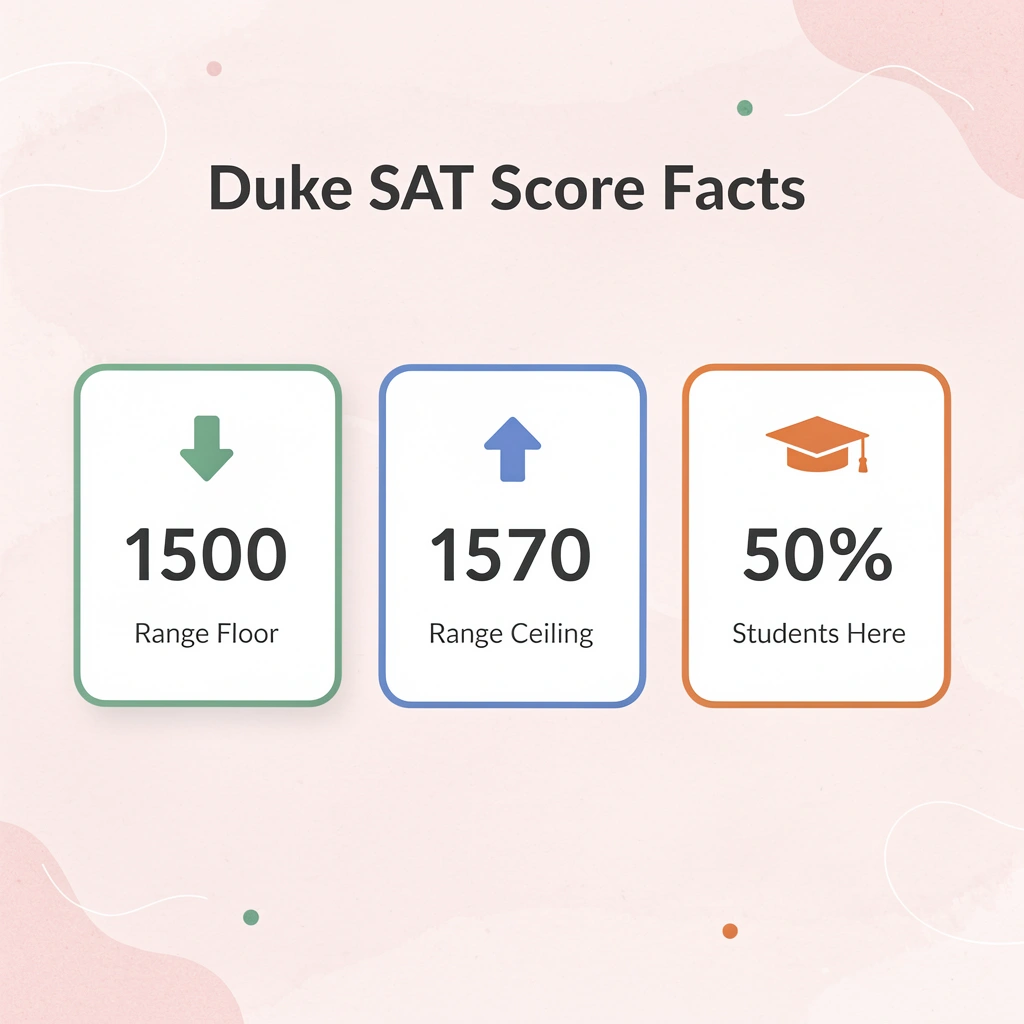
- Duke's middle 50% SAT range for admitted students runs from 1500 to 1570, with 1550 as the threshold at which a score shifts from a potential liability to a quiet asset. Falling below 1460, roughly the 10th percentile of admitted students, meaningfully affects admission odds. Understanding the difference between a floor, a competitive range, and a 75th percentile score changes how students should approach preparation entirely.
- A strong SAT score earns a fair read, not an offer. Only about 6% of applicants who score in the 1520-1570 range ultimately earn a spot in Duke's entering class. A score within the middle 50% signals academic readiness, but admissions officers are asking a different question: what will this student contribute that no one else can?
- Academic rigor carries as much weight as raw GPA. Approximately 95% of enrolled first-year students who reported their class rank placed in the top 10% of their high school class, according to Duke's Common Data Set. Admissions officers read transcripts, looking past the headline number to assess what it cost a student to earn those grades, meaning course selection often separates applicants with identical grade profiles.
- The retake decision is rarely as straightforward as comparing a score to a benchmark. Students already scoring within Duke's admitted range face a real opportunity cost calculation, where weeks of additional test prep may deliver less value than strengthening an essay, deepening an extracurricular commitment, or pursuing an independent project. The retake only makes clear strategic sense when the current score falls measurably below the range, a specific section weakness has been identified, and there is enough runway before deadlines to prepare without sacrificing GPA or meaningful activities.
- Context shapes how Duke reads every part of an application. Fifteen percent of enrolled students are first-generation college students, and Duke explicitly considers that status in its review. Achievement evaluated relative to opportunity, not just in absolute terms, means a student who earned strong grades while navigating significant constraints presents a fundamentally different case than one with identical numbers and a full support structure.
- Kollegio's AI college counselor addresses the gap between knowing your SAT score and understanding how it interacts with your full academic profile, essays, and extracurricular record against Duke's real admissions expectations.
Why Students Ask What SAT Score Is Required for Duke
Students applying to Duke aren't confused about what the university values. They're anxious about where they stand—and that anxiety has a specific shape: a number, the SAT score.
🎯 Key Point: For most applicants, the SAT score feels like the one concrete, controllable variable in an otherwise unpredictable admissions process.

The pressure makes sense. According to the Cosmic College Consulting Duke Common Data Set 2025-2026, Duke's acceptance rate is about 3.3% for the Class of 2028. When fewer than 4 out of every 100 applicants receive an offer, students seek clear signals that distinguish competitive applications. The SAT score feels like that signal because it's measurable, comparable, and improvable in ways that "leadership potential" or "intellectual curiosity" are not.
"Duke's acceptance rate is about 3.3% for the Class of 2028—meaning fewer than 4 out of every 100 applicants receive an offer of admission." — Cosmic College Consulting, Duke Common Data Set 2025–2026
🔑 Takeaway: A 3.3% acceptance rate drives the perception that every SAT point is high-stakes. With odds this narrow, students rely on quantifiable metrics as their clearest path to standing out.
⚠️ Warning: Treating the SAT score as the only signal of competitiveness is a common mistake, but understanding where you stand on this metric remains an essential first step.
Why does searching for a single required score miss the point?
Looking for a single required score is the wrong question, but it points to the right instinct. Students who ask it are asking: "Do I have a realistic chance?" That's fair and deserves a specific answer rather than vague reassurance about "holistic review." Most students have heard that line. It doesn't help them decide whether to sign up for another SAT prep course or invest energy elsewhere.
The familiar approach—Google "Duke SAT requirements," scan numbers, decide whether to keep Duke on the list—breaks down when you realize those numbers don't show how your score interacts with your GPA, course rigor, or extracurricular depth. Our AI college counselor at Kollegio addresses that gap by pulling from thousands of data points to show how your full academic profile compares to Duke's admitted class.
What context does the actual Duke SAT data provide?
What students need isn't a cutoff—it's context. The AdmitStudio Duke SAT analysis notes that applicants should avoid falling below 1460, which represents roughly the 10th percentile of admitted students. That's a floor, not a goal. A student with a 1480 and one with a 1540 face different strategic choices, even though both scores clear that threshold.
The question "what SAT score do I need for Duke?" opens a broader conversation about fit, positioning, and your application's strengths. The answer, based on actual data, is more specific than you might expect.
Related Reading
- What ACT Score Is Needed for Harvard
- Average Act Score For Nc State
- Average Sat Score For Unc
- Average Sat Score For Umd
- Average Sat Score For Uc Berkeley
- Average SAT Score for Virginia Tech
- Average Sat Score For Brown
- Average SAT Score for UVA
- Average SAT Score for Michigan
- Average Sat Score For Ohio State
What SAT Score Is Required for Duke?
Duke's middle 50% SAT range shows where most admitted students scored, but not the minimum needed to be competitive. According to Duke Undergraduate Admissions, the middle 50% SAT score range is 1500 to 1570. Half of the admitted students who submitted scores fell within this band; the other half scored above or below it.
"The middle 50% SAT score range for Duke admitted students is 1500 to 1570 — meaning half of all admitted applicants who submitted scores landed in this window." — Duke Undergraduate Admissions
🔑 Takeaway: A score of 1500–1570 places you squarely within Duke's most common admitted student range — but scoring above 1570 gives you a measurable edge in one of the nation's most selective applicant pools.
⚠️ Warning: The middle 50% range is not a minimum cutoff — it simply reflects where the bulk of admitted students landed. Scoring below 1500 doesn't automatically disqualify you, but it does make your application significantly harder to advance.
What does the 25th percentile boundary actually tell you?
The 25th percentile is the floor of that middle band, not the floor of the applicant pool. Students below it do get admitted, but only because of exceptional strength elsewhere in their applications. Cosmic College Consulting identifies 1550 as the recommended threshold for genuine competitiveness, which places it in the upper half of that middle range. Think of 1550 not as a magic number but as the point where your SAT stops being a liability and becomes a quiet asset.
Why does clearing the SAT bar still leave applications short?
A common pattern emerges among applicants who score within this range yet still receive rejections: the score met the bar, but the rest of the application lacked distinctive weight. A 1550 signals academic readiness, but not fit, intellectual depth, or the specific contribution that makes an admissions reader pause. Those signals live in your essays, your activities, and the story your recommenders tell about you.
How do you find your actual position in the applicant pool?
Most students research SAT benchmarks online and stop there. With acceptance rates below 5%, a single data point reveals almost nothing about your position in the applicant pool. Platforms like Kollegio pull thousands of data points across your full profile to show where your application is strong and where it needs work, providing the strategic clarity that once required an expensive private counselor.
Why do score submission decisions carry real consequences
Not submitting a score isn't neutral. Admissions officers are experienced readers, and a missing score from an otherwise strong academic applicant raises questions. Students scoring at or above 1500 are generally better served by submitting. Students below 1450 face a different situation where the score may do more harm than silence.
Knowing your score is competitive doesn't tell you whether your application is competitive—this gap is where most students lose ground without realizing it.
Is Your SAT Score Competitive for Duke?
Knowing your SAT score is competitive gets you to the starting line. What happens after that determines whether you build a case or lose ground.
🎯 Key Point: A competitive SAT score is necessary but never sufficient on its own. The application you build around that score separates admitted students from the rest.
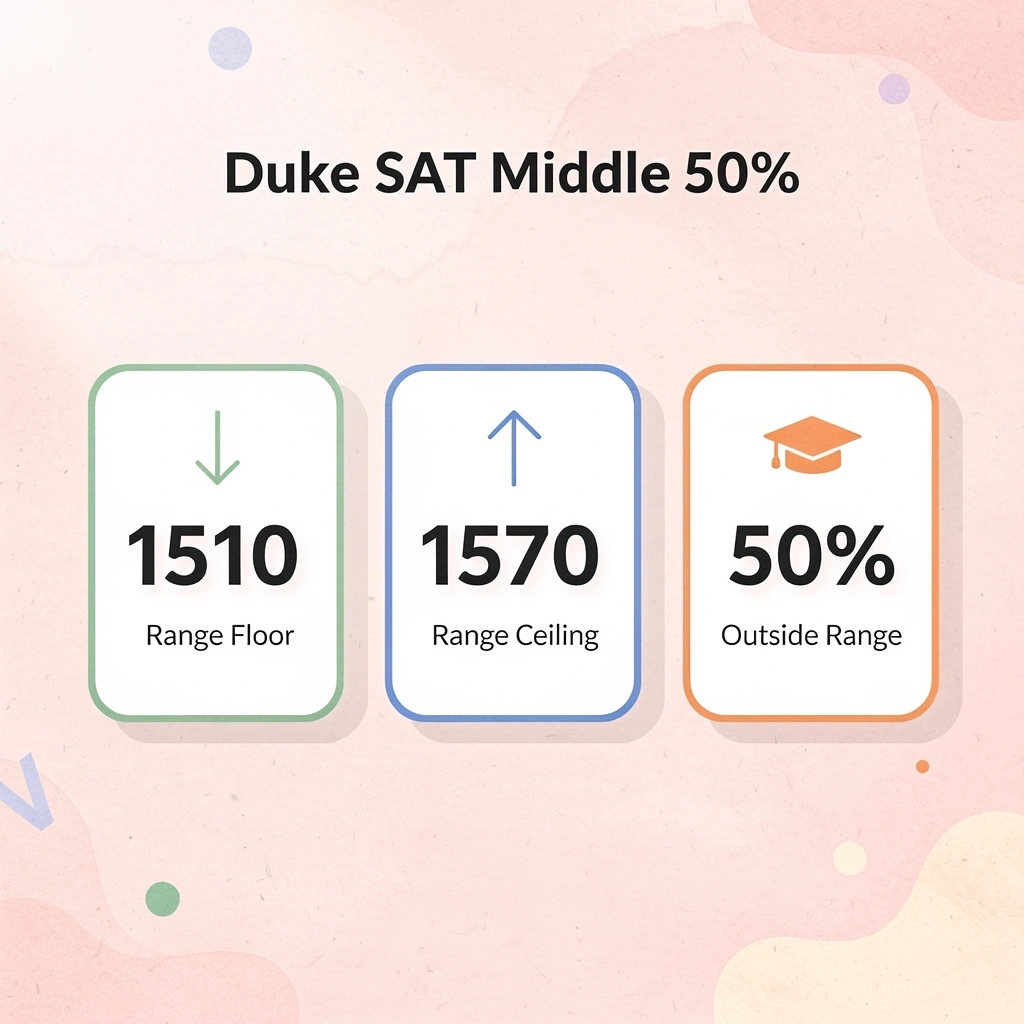
"Duke's SAT middle 50% range is between 1510 and 1570 — meaning half of all admitted students scored outside that window entirely." — Cosmic College Consulting
According to Cosmic College Consulting, Duke's SAT middle 50% range sits between 1510 and 1570. A score within that range means you are academically aligned with many admitted students — but alignment is not the same as advantage. Students admitted at this level typically have full applications that back up the test score: genuine intellectual drive, meaningful commitments, and a clear sense of purpose.
🔑 Takeaway: Scoring in Duke's 1510–1570 range puts you in the game — but intellectual drive, real commitments, and purposeful storytelling are what actually close the deal.
When your score is in range but your application isn't
A pattern emerges among competitive applicants: strong SAT scores paired with thin or undifferentiated profiles. A student with a 1550 who has maxed out course rigor but lists shallow extracurriculars faces a significant problem because Duke is not assembling a class of test-takers. It is building a community. Admissions officers ask: "What will this student contribute that no one else can?" rather than "Is this student academically capable?"
Where does preparation typically break down for competitive applicants?
That gap between a competitive score and a competitive application is where preparation often breaks down. Most students research Duke's SAT benchmarks independently, without applying the same scrutiny to the rest of their profile. Our AI college counselor addresses this directly, using thousands of data points to evaluate your full profile, including essays, activities, and college fit.
What a low GPA and a high SAT actually signal
A 1590 SAT alongside a 3.26 GPA raises a question your application must answer. Duke's contextual review means admissions officers will investigate why that gap exists: whether it is due to chronic illness, a difficult home environment, or limited course offerings. An upward trend in grades paired with a compelling personal narrative can reframe that inconsistency as evidence of resilience rather than a red flag.
Does a high SAT score reduce your risk of rejection at Duke?
AdmitStudio reports that only about 6% of all applicants earn a spot in Duke's entering class, even among those scoring 1520 to 1570. Your SAT score does not reduce risk at Duke; it only earns you a fair read. What converts that into an offer is everything the score cannot show: how you think, what you have built, and who you are when no one is measuring you.
The factors Duke weighs beyond your score are more specific and human than most applicants expect.
What Other Factors Does Duke Consider?
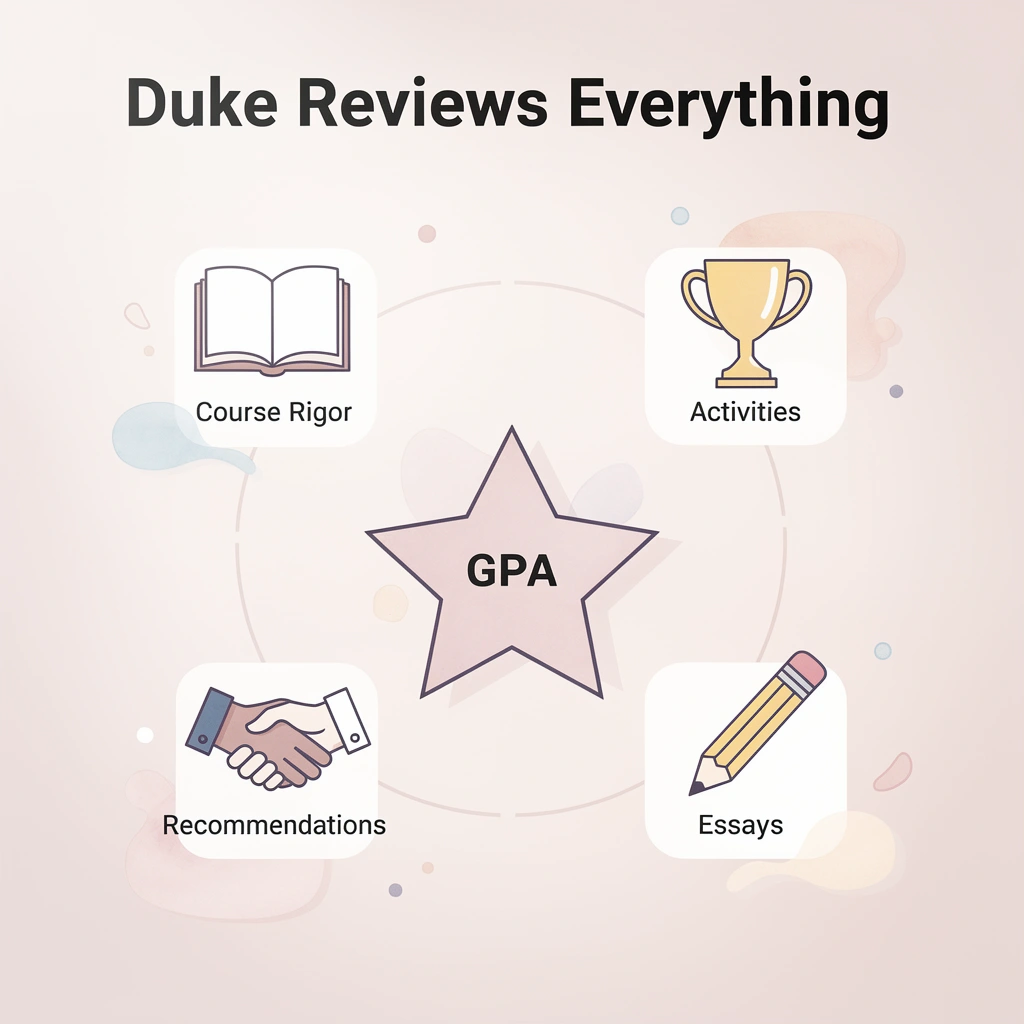
Duke's admissions process rewards students who have built something real, not just scored well. Your GPA, course rigor, extracurricular depth, essays, and recommendations each carry significant weight and interact in ways a single number cannot. A student with a 1560, six AP courses, a community initiative, and a genuine essay about failure presents a fundamentally different case than someone with the same score and a thin supporting profile.
"A student with a 1560, six AP courses, a community initiative, and a genuine essay presents a fundamentally different case than someone with the same score and a thin supporting profile."
🎯 Key Point: Duke evaluates your entire profile holistically — no single factor, not even a perfect score, guarantees admission or disqualifies you.
💡 Tip: Focus on building depth in a few meaningful areas rather than padding your application with surface-level activities. Duke wants to see what you've actually built, not just what you've listed.
How academic rigor separates similar applicants
The difference between two applicants with the same GPA often comes down to which courses they took. According to the Duke Common Data Set 2023-2024, 95% of enrolled first-year students who reported class rank were in the top 10% of their high school class. At this level, strong grades are expected. What sets applicants apart is whether those grades came from challenging courses. Admissions officers look past the number itself to assess what you had to do to earn it.
What extracurriculars actually signal
The failure point for most extracurricular sections is breadth without depth. A list of 12 clubs joined in senior year signals resume-building rather than genuine commitment. Duke wants evidence that you pursued something consistently, took on real responsibility, and created measurable impact: coaching younger students, publishing independent research, or building a small business. Depth in two or three areas reads stronger than surface-level participation across ten.
How do you frame experiences so admissions readers respond?
Most students prioritize making their applications look impressive rather than sharing what shaped them. This instinct produces applications that feel polished rather than authentic. Kollegio's AI college counselor helps students identify which experiences genuinely strengthen their profile and frame them with the specific details that admissions readers respond to, without the guesswork that usually requires a $10,000 private coach.
Why first-generation status and financial context matter
Duke's holistic process extends to context. According to the Duke Common Data Set 2025-2026 via Cosmic College Consulting, 15% of enrolled students are first-generation college students, and Duke considers that status in admissions. This signals that Duke evaluates achievement relative to opportunity, not in absolute terms alone. A student who earned strong grades while working part-time and navigating a family without college experience demonstrates a different kind of resilience than one with identical grades and full support. Context is not an excuse; it is evidence.
Essays are where the application becomes a person
Recommendations and essays make you three-dimensional in ways nothing else can. A teacher describing how you pushed back against a flawed assumption or revisited a problem three times before solving it gives admissions officers something concrete. The strongest essays don't explain accomplishments; they show how you think. They reveal how you handle difficulty, what interests you, and why Duke specifically fits your direction.
Once you understand how these factors work together in a real application, the next question becomes personal: whether changing your SAT score would make a difference or whether your energy belongs elsewhere.
Related Reading
- What Sat Score Is Required For Uf
- Average Sat Score For Uga
- Average Act Score For Georgia Tech
- Northwestern Average SAT Score
- Average Sat Score For Georgetown
- Rice University Average Sat Score
- Caltech Average Sat Score
- What Is The Combined Essay Score For Sat
- What SAT Score Is Required for Cornell
Should You Retake the SAT for Duke?
Deciding whether to retake the SAT for Duke comes down to one critical question: where does your score sit compared to Duke's admitted-student range, and what would you actually do with more preparation time? If your score falls below that range, a retake makes sense. If you're already inside it, the math changes entirely.
"The decision to retake isn't just about raw score potential — it's about whether additional preparation time will move the needle enough to matter for Duke's highly selective admitted-student range." — College Admissions Strategy
🎯 Key Point: A retake is worth it if your score sits below Duke's middle 50% range — but if you're already within or above that band, your time may be better spent elsewhere in your application.
⚠️ Warning: Don't retake the SAT just to retake it. Aimless preparation without a structured study plan rarely produces meaningful score gains — and can cost you valuable application time.

Where does your score sit relative to Duke's admitted range?
According to Duke Undergraduate Admissions, the middle 50% SAT range for admitted students is 1500-1570. A student with a 1460 score has a clear gap to close, and closing it meaningfully changes their academic profile. A student with a 1540 score competes within that range; the question becomes whether another 20 points justifies weeks of preparation time that could strengthen a weak essay, research project, or leadership role.
Is the retake decision more than just a numbers game?
The failure point most students hit is treating the SAT retake decision purely as a mathematical one. A common pattern surfaces in applications where a student has maxed out every measurable metric—strong GPA, rigorous coursework, competitive scores—but the extracurricular section reads as a résumé built for college rather than a life lived. At a school where Test Ninjas reports that scoring below the 25th percentile can meaningfully affect admission odds, the retake argument holds weight. But for students already scoring within range, the opportunity cost of another test cycle often exceeds the marginal gain.
The real variable is not the score itself but how the score interacts with every other element of your application. Our AI college counselor at Kollegio is built on thousands of real admissions data points and can map that interaction clearly, showing where a retake moves the needle versus where your time builds more value elsewhere.
When do all the conditions actually justify a retake?
Taking the SAT again makes sense under three conditions: your current score falls below Duke's typical range, you've identified a specific section weakness, and you have sufficient time to prepare before deadlines without compromising your GPA or extracurricular involvement. All three must be present. If any is missing, the case for retaking weakens considerably.
How you use your remaining preparation time before submitting your application demonstrates how you think clearly under pressure, something Duke's admissions process is designed to identify.
How Kollegio Helps Students Build Stronger Duke Applications
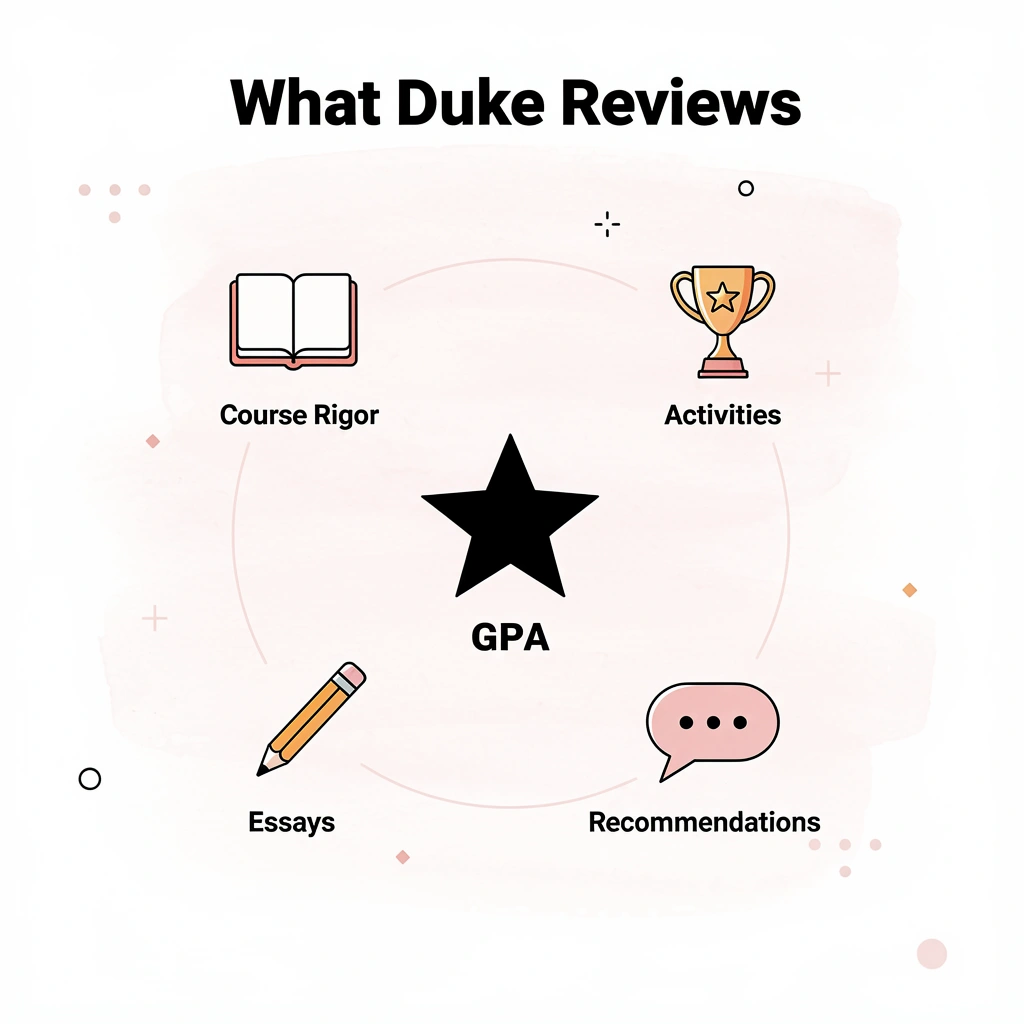
Duke looks at much more than SAT scores when reviewing applications — grades, course rigor, extracurricular activities, leadership, essays, recommendations, and personal achievements all matter. Many students find it hard to understand how their whole application compares to other students' applications and how to make their profile stronger in smart, strategic ways.
"Duke's holistic review means no single factor determines admission — your full profile, from academics to character, is what sets you apart." — Kollegio Admissions Insights
🎯 Key Point: Duke's admissions process is holistic — meaning every part of your application carries weight, not just your test scores.
Kollegio gives personalized college guidance to help students navigate this challenge with clarity and confidence. Rather than guessing, students can discover exactly where they stand academically and how their qualifications align with university requirements, turning uncertainty into a clear, actionable strategy.
💡 Tip: Use Kollegio's personalized guidance to identify your strongest application assets and pinpoint the specific areas where targeted improvement will have the greatest impact on your Duke application.
How does Kollegio help students find the right university fit?
The platform offers university matching based on your academic profile, helping you identify schools that align with your grades, test scores, interests, and goals, rather than applying blindly. Kollegio also provides admissions insights and planning tools to keep you organized throughout the application process.
For applicants targeting highly selective universities like Duke, Kollegio helps you evaluate how your SAT scores, academic performance, and overall profile compare with admissions expectations and identify areas for improvement before applying.
How does Kollegio support the development of a competitive overall application?
Beyond test scores, Kollegio encourages the development of stronger overall applications. Strong extracurricular involvement, leadership experience, compelling essays, and academic achievement all contribute to competitive applications at selective universities.
Our platform helps students discover scholarship opportunities aligned with their achievements, interests, and future plans, an important part of building a successful college strategy for many families.
Why does building a balanced college list improve your chances?
Another advantage is the ability to create balanced college lists that include reach, target, and likely schools. Many students focus only on highly selective universities, but a well-balanced strategy improves the chances of multiple admissions offers and ensures viable options.
Success at Duke comes from understanding your competitiveness, identifying areas for improvement, and building a strong application that demonstrates your academic achievements, experiences, and potential.
Use Kollegio's AI College Counselor for Free Today!
The harder question most students never ask: Is Duke the right fit for who you are, not just who you're trying to become on paper? Knowing your SAT score is competitive gets you to the starting line. Knowing where you belong gets you somewhere worth going.
"The best college application isn't built around prestige — it's built around genuine fit, and students who understand that distinction make smarter, more strategic decisions."
🎯 Key Point: A competitive SAT score is only the beginning. True admissions success starts with understanding whether a school matches your goals, values, and strengths.

Our AI college counselor compares your full academic profile against Duke's real admissions expectations, surfaces your actual chances, and helps you build a strategy around your strengths. The guidance that used to cost $10,000 and a zip code is now free and available to any student willing to ask smarter questions.
💡 Tip: Don't navigate Duke's admissions process alone — use AI-powered tools to get the kind of personalized, data-driven strategy that was once reserved for students with access to elite private counselors.
✅ Best Practice: Use Kollegio's AI college counselor to benchmark your full academic profile against Duke's actual expectations — and walk into the application process with a clear, confident strategy.
Related Reading
- What Sat Score Is Required For Ut
- What Sat Score Is Required For Nyu
- What Sat Score Is Required For Ivy League
- What SAT Score Is Required for Texas A&M
- What Sat Score Is Required For Mit
- What Sat Score Is Required For Harvard
- What Sat Score Is Required For Cornell
- What Sat Score Is Required For Princeton
- What Sat Score Is Required For Stanford
- What Act Score Is Needed For Alabama
- What Sat Score Is Required For Ucla
- What Sat Score Is Required For Notre Dame
- What Is The Combined Essay Score For Sat
- What Sat Score Is Required For Columbia
- What Sat Score Is Required For Yale
Author
Trailblazer Marketing