
What SAT Score Is Required for Yale? Tips to Improve Your Chances
Getting into Yale starts with understanding what SAT score is required for Yale, along with the GPA benchmarks and admission standards that actually move the needle. Yale's middle 50% SAT range is 1500-1580, meaning a strong score is necessary but far from the only factor that matters. Knowing where you stand against admitted students gives you a concrete target to work toward.
Beyond raw numbers, Yale evaluates the full picture of an applicant, including the rigor of coursework, extracurriculars, and essays. Students who understand how each piece fits together are better positioned to build a compelling application. For personalized guidance tailored to your specific profile, Kollegio's AI college counselor can help you identify exactly where to focus your efforts.
Table of Contents
- Why Yale SAT Requirements Cause So Much Confusion
- The Hidden Cost of Chasing a Higher SAT Score
- What SAT Score Is Required for Yale?
- How Competitive Is Your SAT Score for Yale?
- What Yale Looks for Beyond Test Scores
- How Kollegio Helps Students Build Stronger Yale Applications
- Use Kollegio's AI College Counselor for Free Today!
Summary
- Yale's SAT requirement is firm but frequently misunderstood. The university requires 100% of first-year and transfer applicants to submit ACT or SAT scores, a policy restored after a test-optional period that began before 2020. A significant portion of advice circulating online was written during that test-optional window, meaning many students are working from guidance that no longer reflects current admissions policy.
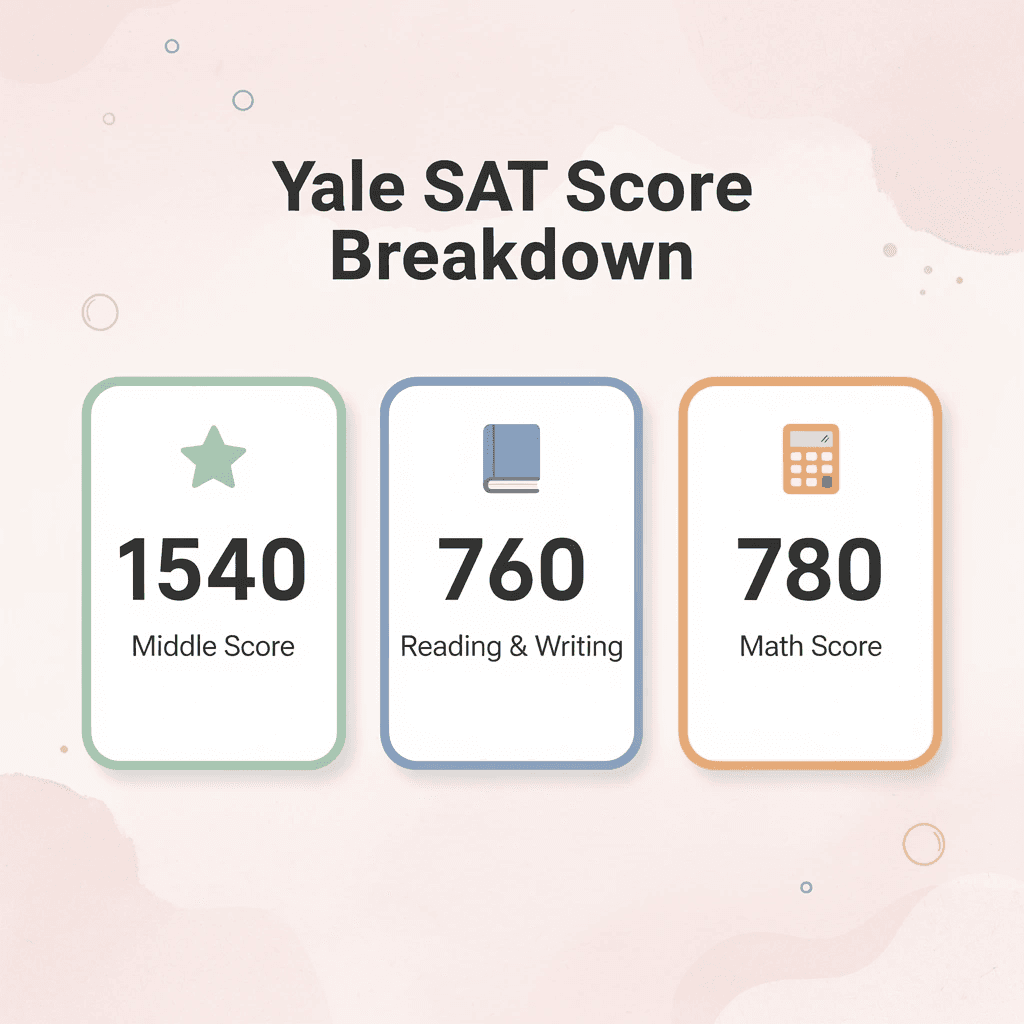
- The middle 50% SAT range for admitted Yale students runs from 1500 to 1570, with a median score of 1540 (760 in Evidence-Based Reading and Writing, 780 in Math). These numbers describe a population, not a cutoff. Roughly 25% of admitted students scored below 1500, and the score's primary function is to signal academic readiness, allowing admissions officers to focus on evaluating everything else in the file.
- Once a score crosses into competitive territory, additional gains produce diminishing returns. SAT tutoring can cost between $45 and $400 per hour, and students who spend months pushing from a 1510 to a 1540 often trade time that could have gone toward research projects, leadership roles, or building the kind of teacher relationship that produces a genuinely compelling recommendation letter. That time cost rarely gets discussed openly, but it shows up clearly in the final application.
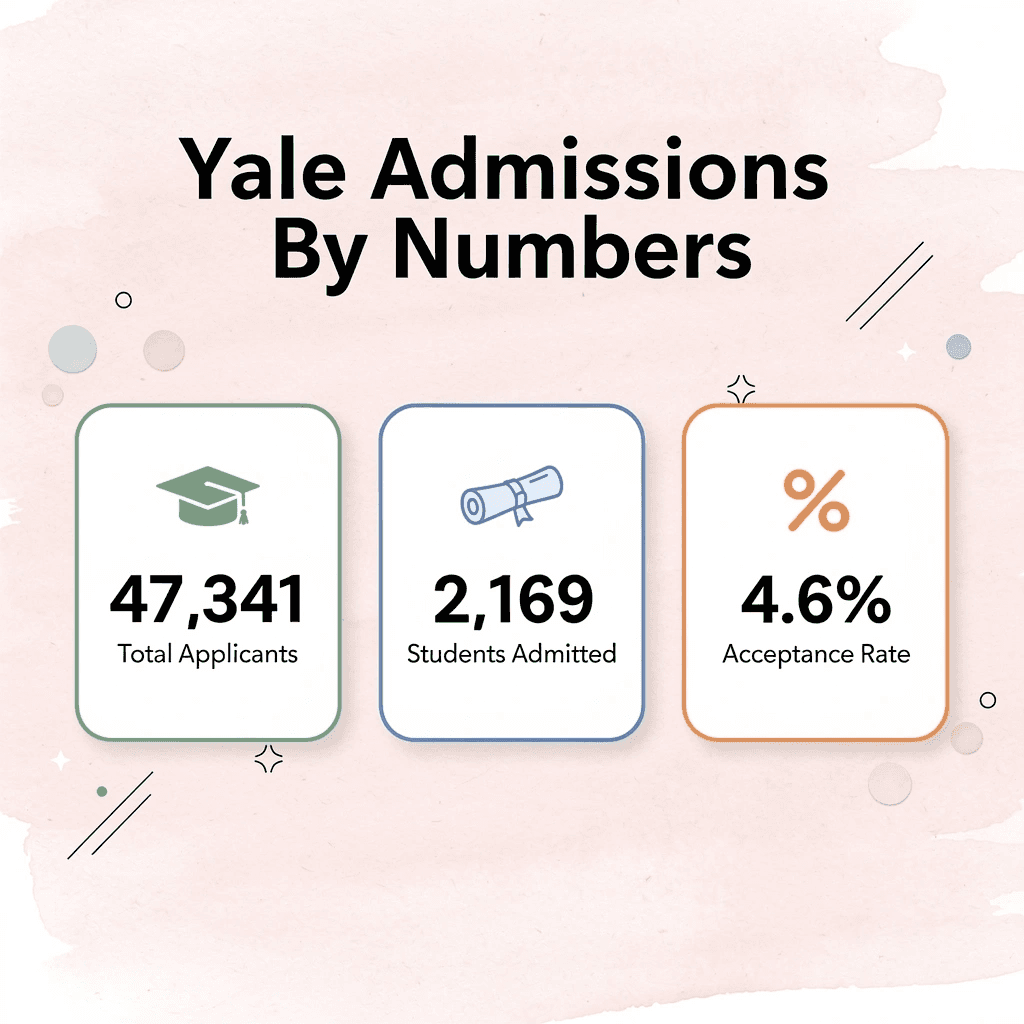
- Yale's acceptance rate for the Class of 2025 was approximately 4.6%, with 2,169 students admitted from 47,341 applicants. Most denied students had strong grades and competitive scores. The gap between admitted and denied applicants at this level is almost never a score difference. It is a specificity gap, meaning admitted students demonstrated real intellectual initiative and depth rather than a collection of credentials assembled to look impressive.
- Extracurricular depth matters more than breadth at highly selective schools. Yale admissions officers consistently look for evidence that a student created or changed something through sustained commitment, not a padded list of club memberships. A student who spent two years leading a single initiative and can articulate what they learned from it is more compelling to an admissions committee than one who logged 10 activities that required minimal investment.
- Access to strategic guidance is unevenly distributed in ways that affect outcomes. There is roughly 1 counselor for every 408 students in U.S. public schools, and only 1 in 5 low-income college-ready students enrolls in a selective college, a gap that reflects strategy and information deficits more than talent. Kollegio's AI college counselor addresses this by evaluating a student's full profile across academic preparation, extracurricular depth, essay coherence, and institutional fit, helping students identify where their application is strong and where it needs work before the deadline.
Why Yale SAT Requirements Cause So Much Confusion
Yale's SAT requirements seem straightforward on paper, yet they create more confusion than almost any other admissions topic. The gap lies between what the policy says and what students think it means, and that gap can derail your preparation strategy.
"The gap lies between what the policy says and what students think it means — and those are two very different things."
🎯 Key Point: The confusion around Yale's SAT requirements isn't about the numbers themselves. It's about misunderstanding what those numbers signal to admissions officers.

According to Yale Undergraduate Admissions, Yale requires 100% of first-year and transfer applicants to submit ACT or SAT scores — no exceptions. But students often ask the wrong question: "What score do I need to get in?" rather than "What does my score need to show?" Those two questions lead to completely different preparation strategies — and choosing the wrong one can cost you.
⚠️ Warning: Focusing only on a target score number is one of the most common mistakes Yale applicants make. Your score must demonstrate academic readiness, not just clear a threshold.
The Wrong Question | The Right Question |
|---|---|
"What score do I need to get in?" | "What does my score need to show?" |
Leads to score-chasing | Leads to strategic preparation |
Focuses on a single number | Focuses on demonstrated ability |
Reactive approach | Intentional approach |
🔑 Takeaway: Reframing your question from "what's the cutoff" to "what does this score communicate" is the single most important mindset shift any Yale applicant can make.
Did Yale's test-optional period make the confusion worse?
The confusion deepens because Yale was test-optional for five years. WTNH News 8 reports that Yale reinstated its requirement after a test-optional period beginning before 2020. Much of the online advice was written in a different admissions environment, and students reading older forums and blog posts often encounter outdated information.
Most students seek a single score threshold as a guarantee. The problem is that Yale's admitted class shows a wide range of SAT scores, and admitted students with lower scores often have exceptional essays, unusual extracurricular depth, or compelling personal circumstances that raw scores cannot capture. Treating the score as a ceiling rather than as one signal among many causes students to misread their competitiveness.
Why does chasing a single score number backfire?
Students spend months chasing a number, retesting repeatedly, and measuring chances against unofficial benchmarks. A student who moves from a 1480 to a 1520 has improved, but whether that changes their admissions outcome depends on factors a score alone cannot answer. Our AI college counselor helps students step back from score fixation and evaluate their full profile using thousands of data points to show where they actually stand.
Yale's admissions process identifies students who are exceptional across multiple dimensions, not those who optimize one metric. A score in the 1500s signals academic readiness but cannot signal intellectual curiosity, the ability to contribute to a campus community, or personal resilience. Admissions officers know the difference, as do the most competitive applicants.
Related Reading
- What ACT Score Is Needed for Harvard
- Average Act Score For Nc State
- Average Sat Score For Unc
- Average Sat Score For Umd
- Average Sat Score For Uc Berkeley
- Average SAT Score for Virginia Tech
- Average Sat Score For Brown
- Average SAT Score for UVA
- Average SAT Score for Michigan
- Average Sat Score For Ohio State
The Hidden Cost of Chasing a Higher SAT Score
Chasing small SAT score gains has a real price. The cost is not measured in dollars spent on prep books, but in the experiences that never happened because test prep crowded them out.
"The cost is not measured in dollars spent on prep books, but in the experiences that never happened because test prep crowded them out."
⚠️ Warning: Every hour spent chasing marginal score improvements is an hour permanently taken from extracurriculars, relationships, and personal growth—things colleges also care deeply about.
💡 Tip: Before committing to another round of intensive SAT prep, ask whether the expected score gain justifies the real-world opportunity cost you're paying.

What You're Trading Away | For What Gain? |
|---|---|
Extracurricular activities | A few extra points |
Personal downtime & mental health | Marginal score improvement |
Meaningful experiences | Diminishing returns on prep |
Time with friends & family | A number on a scorecard |
🎯 Key Point: The hidden cost of over-preparing for the SAT isn't financial — it's the irreplaceable experiences and personal development that get sacrificed in pursuit of a slightly higher score.
What does obsessive SAT prep actually cost students?
According to CNBC, SAT tutoring costs families $45 to $400 per hour. Wealthier families gain more prep time, more retakes, and higher scores. But the benefit diminishes once scores reach the competitive range. A student moving from a 1510 to a 1540 is not meaningfully more attractive to a Yale admissions reader. What they may have lost is three months that could have gone toward a research project, a leadership role, or building the kind of relationship with a teacher that produces a compelling letter of recommendation.
The pattern among applicants to elite universities is clear: students with strong scores, rigorous coursework, and solid extracurricular records still face rejection. A student with a 1500 SAT score gains admission to Cornell while peers with higher scores do not. Another applicant with a 1580 is rejected from schools with lower average admitted scores. These outcomes reflect the reality that once a score signals academic readiness, the admissions conversation shifts entirely to other questions.
Where should students direct their energy instead?
Most students respond by studying more, retaking the test, and grinding toward a number that feels controllable. But every hour spent chasing a 20-point improvement is an hour not spent developing the parts of an application that set candidates apart. Platforms like Kollegio's AI college counselor exist because students need help seeing their full profile clearly, not their score alone, so they can direct their energy where it matters across essays, activities, and fit. Yale and other highly selective universities seek evidence of genuine curiosity, initiative, and personal depth. A student who spent six months conducting chemistry research and can write about a specific problem they solved is more compelling than one who raised their SAT score by 30 points during that same period. The research tells a story. The score does not increase.
How does score fixation affect the rest of the application?
There is also an emotional cost. Students who anchor their self-worth to a standardized test score and fall short often carry that disappointment into the rest of their application process. The pressure to chase a number erodes the confidence and authenticity that strong personal essays require. A score is a floor, not a ceiling; once applicants stand on solid ground, the work of building something worth reading about is what matters. Yet knowing that scores matter less than students assume leaves one uncomfortable question unanswered.
What SAT Score Is Required for Yale?
According to Yale Undergraduate Admissions, 100% of first-year and transfer applicants must submit ACT or SAT scores. But required is not the same as decisive — a distinction that matters more than most applicants realize.
"100% of first-year and transfer applicants must submit ACT or SAT scores — yet test scores alone will never make or break a Yale application." — Yale Undergraduate Admissions
🎯 Key Point: Submitting a strong SAT score is mandatory at Yale, but it functions as a threshold signal — not the deciding factor in your admission.
🔑 Takeaway: Yale's test-required policy means there is no hiding a weak score — which makes hitting the competitive score range an essential part of your application strategy.
Requirement | What It Means for Applicants |
|---|---|
Test submission: required | Every applicant must submit ACT or SAT scores — no exceptions |
Score as a decisive factor | Scores are one component among many — not the sole determinant |
Competitive score range | Hitting the top percentile range strengthens your overall profile |

What does the middle 50% SAT range actually tell you?
The Koppelman Group's Yale admissions analysis shows that the middle 50% of admitted students scored between 1500 and 1570 on the SAT. About 25% of admitted students scored below 1500, and another 25% scored above 1570. A score in this range signals to the admissions committee that you have adequate academic preparation, allowing them to evaluate other application components. However, it does not make you competitive on its own.
Many applicants get frustrated because they believe a strong test score will help them stand out. A score within Yale's range demonstrates you can handle the academic work, but it does not distinguish you from thousands of other applicants with identical scores. Students who score 1550 and face rejection learn what a holistic review means when many applicants share the same strong academic credentials.
Why does clearing the score threshold only get you so far?
Most students treat test scores like visa requirements: get the document, assume the door opens. A more useful perspective: your score gets you past the first checkpoint. What happens after is a different conversation. Applicants who understand this stop optimizing for a number and start building the parts of their application that cannot be reduced to a single data point. Our AI college counselor helps students see their full profile clearly, mapping essays, activities, and fit against thousands of data points rather than fixating on a score benchmark that most competitive applicants already meet.
Why is the score just the beginning
The pattern among rejected applicants with strong scores is a gap between academic preparation and demonstrated intellectual identity. Yale selects for students who think distinctly, contribute meaningfully, and bring something unreplicable to campus. A score proves you can do the work. Your essays, activities, and recommendations prove you are worth doing it with. Yet knowing your score is competitive leaves one unresolved tension most applicants never consider.
How Competitive Is Your SAT Score for Yale?
According to LifeWorks, Yale's middle SAT score is 1540. This breaks down to 760 in Evidence-Based Reading and Writing and 780 in Math. A score at or near the middle means you've passed an academic requirement, but it doesn't guarantee you'll get in.
"Yale's middle SAT score is 1540 — breaking down to 760 in Evidence-Based Reading and Writing and 780 in Math." — LifeWorks
🔑 Takeaway: Hitting 1540 puts you in the competitive range, but Yale's admissions process is holistic — your SAT score is just one piece of the puzzle.
⚠️ Warning: A 1540 is not a guaranteed admit. Scoring at the middle range means roughly half of admitted students scored higher — so every point above 1540 meaningfully strengthens your application.
SAT Section | Yale Middle Score |
|---|---|
Evidence-Based Reading & Writing | 760 |
Math | 780 |
Total Composite | 1540 |
What does landing in the middle 50% actually mean for your application?
Students often treat score ranges as admission probabilities, assuming that landing in the middle 50% makes them competitive. It doesn't. It makes them legible—admissions officers can read the rest of your file with confidence that you can handle the coursework. What they're reading for is something a score cannot convey.
How does your score range change the problem you're solving?
Students scoring below 1480 face a steeper path because the academic signal is weaker and everything else must compensate. Students scoring above 1560 face a different problem: they share that range with hundreds of other applicants, and the score stops being a differentiator. The score's job is to get you into the conversation. Your job is to make the conversation worth having.
Where is the real leverage in a Harvard or Yale application?
Most applicants spend months improving their scores in ways that don't help as much as a stronger essay or more meaningful activity list would. A common pattern: students retake tests all summer to gain 20 points while weaker parts of their application remain unchanged. Our AI college counselor helps students identify where they can make the most difference, rather than focusing solely on the score that feels easiest to control.
When score improvements stop paying off
According to LifeWorks, Yale's SAT middle 50% range runs from 1480 to 1580. Above 1520, the difference between your score and a 1570 is negligible in admissions. Both demonstrate academic readiness. Spending three more months testing to close that gap diverts time from the application components that distinguish admitted from denied candidates. Score competitiveness is a threshold question, not a ranking question. Cross the threshold and the score fades into the background. What Yale then evaluates is harder to measure and far more personal than any standardized test can capture.
What Yale Looks for Beyond Test Scores
Yale gets applications from students who have already done well in their classes. According to Ivy Coach, Yale admitted around 2,169 students out of 47,341 applicants for the Class of 2025. Most students who were not admitted had strong grades and competitive scores — test performance alone was never the deciding factor.
"Yale admitted around 2,169 students out of 47,341 applicants for the Class of 2025 — meaning roughly 95.4% of applicants were rejected, many with stellar academic records." — Ivy Coach
🎯 Key Point: With an acceptance rate of under 5%, Yale's admissions process goes far beyond grades and scores — holistic evaluation is the real deciding factor.
🔑 Takeaway: 47,341 applicants competed for just 2,169 spots, proving that academic excellence is the baseline, not the differentiator. What sets admitted students apart is everything beyond the numbers.
Admissions Metric | Class of 2025 Data |
|---|---|
Total Applicants | 47,341 |
Students Admitted | 2,169 |
Acceptance Rate | ~4.6% |
Primary Deciding Factor | Beyond test scores |
What admissions officers actually read for
The critical difference between applicants who get in and those who don't is rarely a test score gap. It is a specificity gap. Yale's admissions officers read for evidence that a student has done something real with their curiosity, not performed well in structured environments. A student who spent a summer investigating local water quality data and presented findings to a city council has demonstrated more intellectual initiative than one who lists AP Environmental Science on a transcript. The activity itself matters less than what it reveals about how the student thinks and acts when nobody is assigning the work.
Does depth matter more than breadth on a Yale application?
Yale would rather see two years of sustained commitment to a single initiative, especially one where the student created or changed something, than a resume padded with club memberships. Depth signals character. Breadth signals anxiety.
Why personal qualities carry real weight
Yale values personal qualities like integrity, resilience, and collaboration—not as extra features, but as signs of meaningful contribution to seminars, research teams, and campus organizations. Admissions officers rely on recommendation letters to demonstrate these qualities, since transcripts cannot show how a student handles failure, supports peers, or leads without authority.
How does the way you frame your application change what Yale sees?
Many students treat applications as credential submissions rather than introductions, producing resumes instead of portraits. Those who write supplemental essays that authentically connect their experiences to Yale's intellectual culture, ask recommenders to speak to moments of growth, and treat the application as a conversation stand out. Our AI college counselor at Kollegio can help identify where a profile is genuinely strong and where it needs depth, enabling students to invest time in the parts that move the needle.
Why is Yale assembling a community rather than ranking credentials?
Yale is building a community, not a class rank. Every admitted student brings something unique that others do not have, and that something is almost never a test score. Knowing what Yale values is only half the equation. The harder question is how to build an application that demonstrates it.
Related Reading
- What Sat Score Is Required For Uf
- Average Sat Score For Uga
- Average Act Score For Georgia Tech
- Northwestern Average SAT Score
- Average Sat Score For Georgetown
- Rice University Average Sat Score
- Caltech Average Sat Score
- What Is The Combined Essay Score For Sat
- What SAT Score Is Required for Cornell
How Kollegio Helps Students Build Stronger Yale Applications
Building a strong Yale application requires coherence—the parts must tell the same story. Most students have no clear way to see whether they actually do. A student might have a 1540 SAT, strong teacher recommendations, and three years of math competition results, yet face rejections because nothing connects those pieces into a compelling portrait of who they are and what they will contribute. Strong individual components do not automatically add up to a competitive application at a school like Yale.
🎯 Key Point: A 1540 SAT and impressive extracurriculars mean nothing if your application lacks a unifying narrative — Yale reads for coherence, not just credentials.
"Strong individual components do not automatically add up to a competitive application — the parts must connect into a compelling portrait of who you are and what you will contribute." — Core Principle of Yale Admissions
💡 Tip: Before submitting, audit every element of your application — test scores, recommendations, essays, and activities — and ask: do these all point toward the same story?
Application Element | What Yale Is Looking For |
|---|---|
SAT/ACT Scores | Academic readiness, not just a high number |
Teacher Recommendations | Evidence of intellectual curiosity and character |
Extracurriculars | Depth and commitment, not a laundry list |
Essays | A coherent narrative that ties everything together |
Awards & Competitions | Contextual proof of the story you're telling |

Why do most applicants lack personalized admissions guidance?
A common answer is to ask a parent, school counselor, or classmate to read over essays. According to the Kollegio AI Blog on counselor outcomes, there is about 1 counselor for every 408 students in U.S. public schools, so most applicants lack consistent, personalized help. Feedback from classmates helps with basic clarity but usually misses larger strategic problems: a story that contradicts itself across essays, or an activity list that shows many interests when Yale values deep focus.
How does Kollegio evaluate a student's full application profile?
Our AI college counselor at Kollegio evaluates a student's full profile across areas that affect selective admissions results: academic preparation, extracurricular depth, essay coherence, and institutional fit. Instead of providing a single score or generic verdict, it identifies specific gaps and strengths, enabling students to make targeted decisions about where to focus their remaining time before submitting. Research from the Kollegio AI Blog shows that only 1 in 5 low-income students who are college-ready enroll in a selective college. This reflects a strategy and information gap, not a talent gap. Knowing your Yale SAT score range is competitive is a starting point, not a plan.
What actually changes outcomes for Yale applicants?
What changes outcomes is understanding how your profile reads as a whole, which essays reinforce your narrative, which activities demonstrate genuine investment, and which parts create doubt rather than conviction. That clarity, once available only to students with access to expensive private counselors, is now within reach regardless of zip code or budget.
Related Reading
- What Sat Score Is Required For Ut
- What Sat Score Is Required For Nyu
- What Sat Score Is Required For Ivy League
- What SAT Score Is Required for Texas A&M
- What SAT Score Is Required for Duke
- What Sat Score Is Required For Harvard
- What Sat Score Is Required For Cornell
- What Sat Score Is Required For Princeton
- What Sat Score Is Required For Stanford
- What Act Score Is Needed For Alabama
- What Sat Score Is Required For Ucla
- What Sat Score Is Required For Notre Dame
- What Is The Combined Essay Score For Sat
- What Sat Score Is Required For Columbia
- What Sat Score Is Required For Yale
Use Kollegio's AI College Counselor for Free Today!
Our AI college counselor looks at your full academic profile — SAT scores, extracurricular activities, essay quality, and school fit — and gives you a personalized strategy that would otherwise cost $10,000 with a private counselor. Students from all backgrounds are already using it to build stronger, more competitive applications.
"Personalized college counseling that once cost $10,000 is now accessible to every student — regardless of background or budget." — Kollegio AI
💡 Tip: Don't leave your college strategy to guesswork. The same data-driven insights that elite students pay thousands for are now available instantly through Kollegio's AI counselor.
What You Get | Traditional Counselor | Kollegio AI |
|---|---|---|
Personalized Profile Review | ✅ | ✅ |
SAT & Academic Analysis | ✅ | ✅ |
Essay Quality Feedback | ✅ | ✅ |
School Fit Assessment | ✅ | ✅ |
Cost | ~$10,000 | Free |

Start today before critical deadlines pass. Visit Kollegio to see where your Yale application stands and get the actionable, personalized roadmap you need to move forward with confidence.
🎯 Key Point: Every day you wait, your competitors gain ground. Your application strategy starts now.
⚠️ Warning: Deadlines don't wait. Students who start college planning early are statistically more likely to submit polished, competitive applications. Don't be the one scrambling at the last minute.

Author
Senan KhawajaSenan Khawaja is the Co-Founder and CEO of Kollegio, an AI-native college counseling and institutional recruiting platform serving roughly 250,000 students across 190 countries. A Stanford graduate, repeat founder, and Forbes 30 Under 30 honoree with World Bank experience, Senan launched Kollegio to democratize elite college counseling—addressing the 400:1 student-to-counselor ratio in public schools. Under his leadership, Kollegio has secured 22+ institutional partners with a 100% renewal rate and backing from Reach Capital, JFF Ventures, and ECMC Group. He was also selected for OpenAI's inaugural ChatGPT Futures Class of 2026. Senan is based in New York City.